Razer Leviathan V2 is one powerful subwoofer and PC soundbar
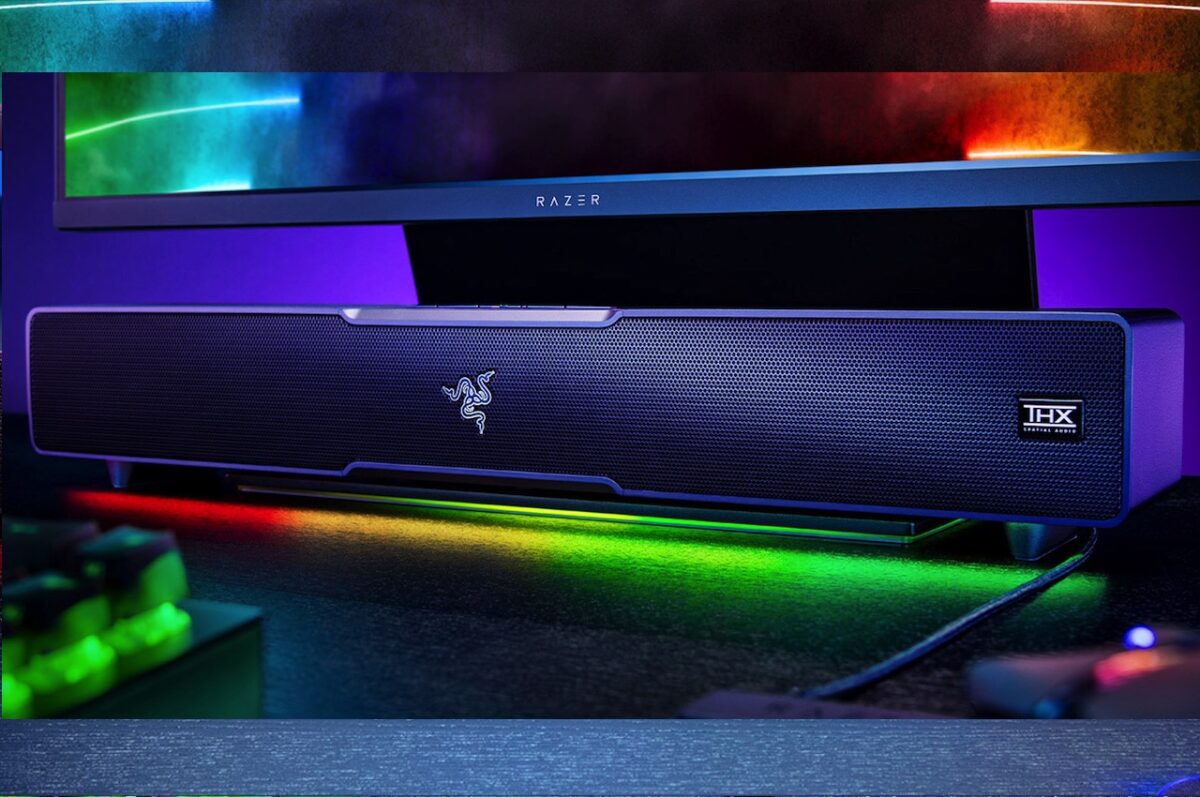
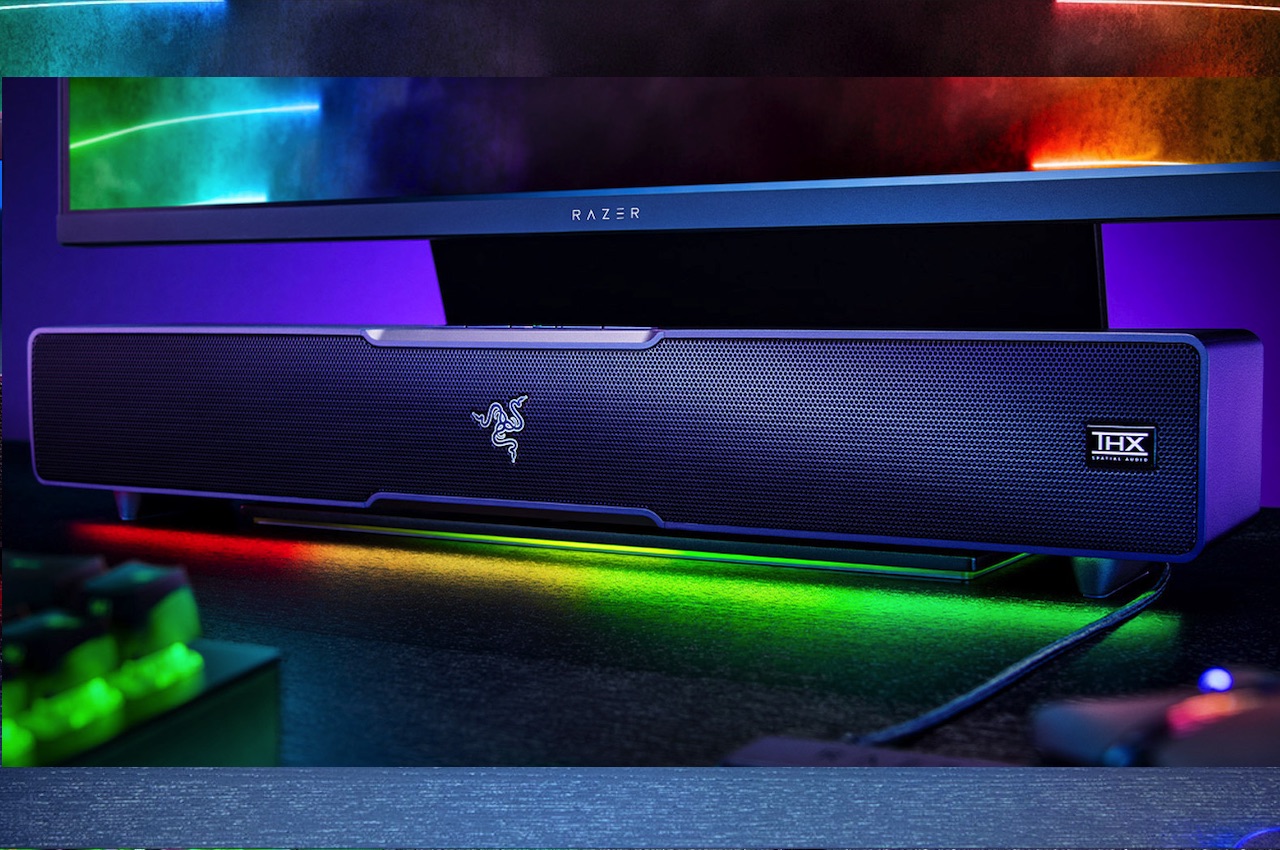
Razer appears to be expanding into consumer electronics. The company sells keyboards, mice, smartphones, and other peripherals for computers. It has also released headsets and speakers, with the most notable, the Leviathan Soundbar, getting a follow-up. The new Razer Leviathan V2 is ready to illuminate your sound. This new soundbar, with its multi-drivers, is perfect for gaming.
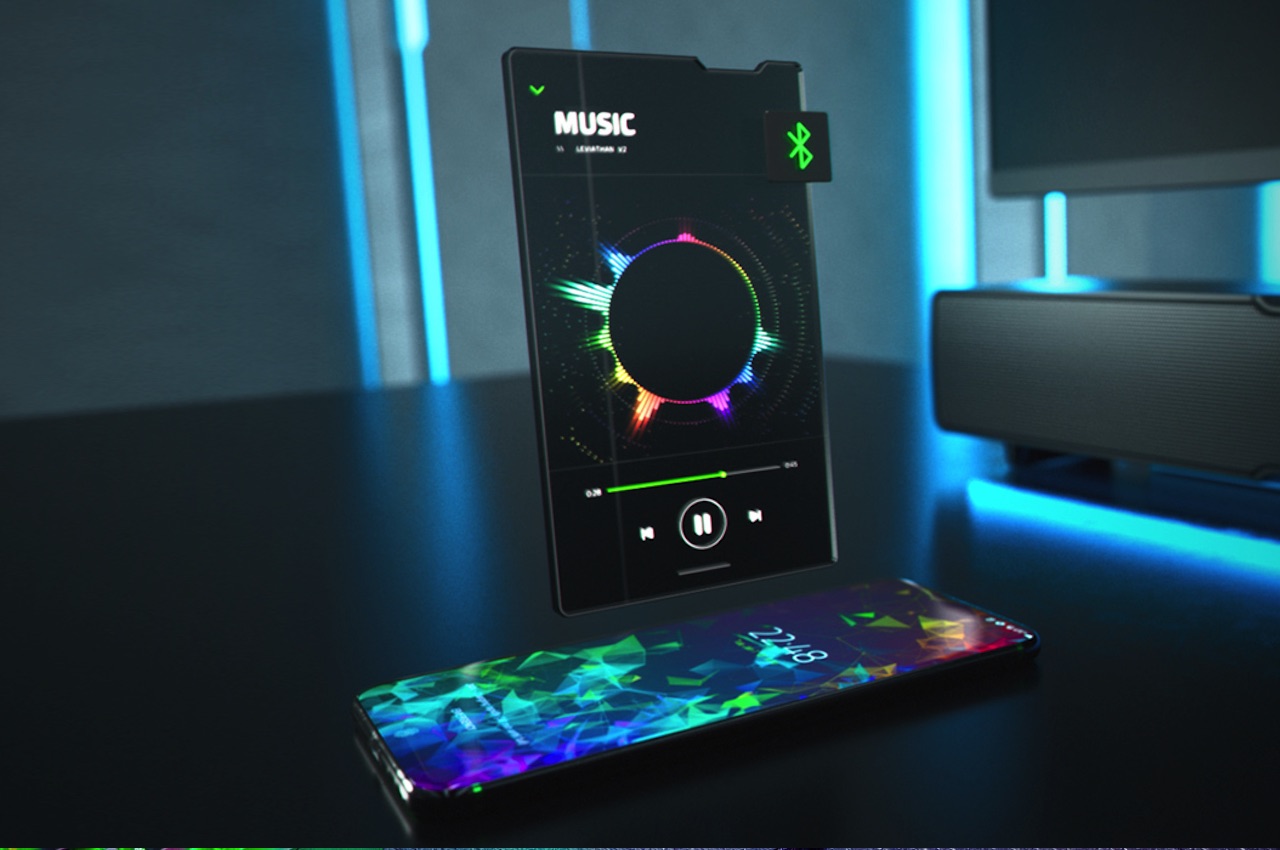
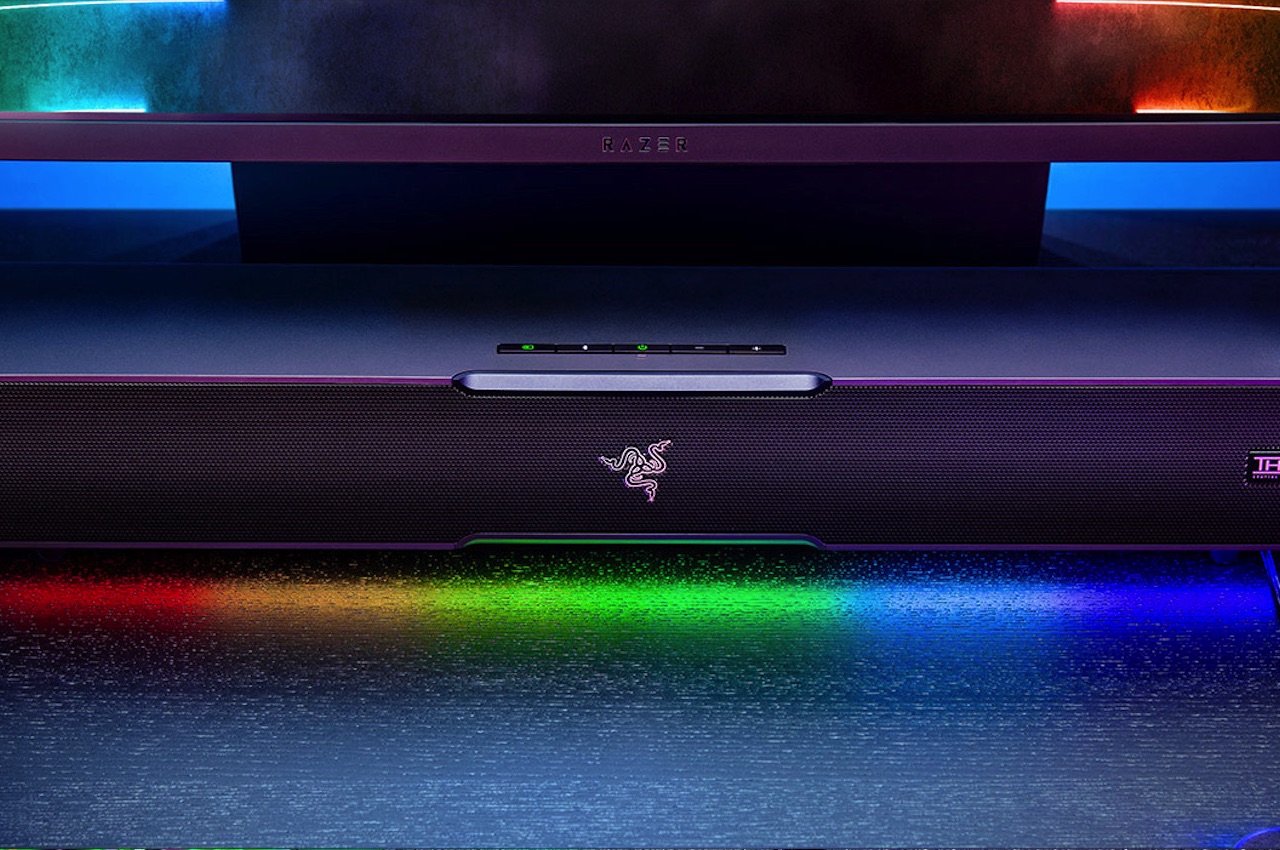
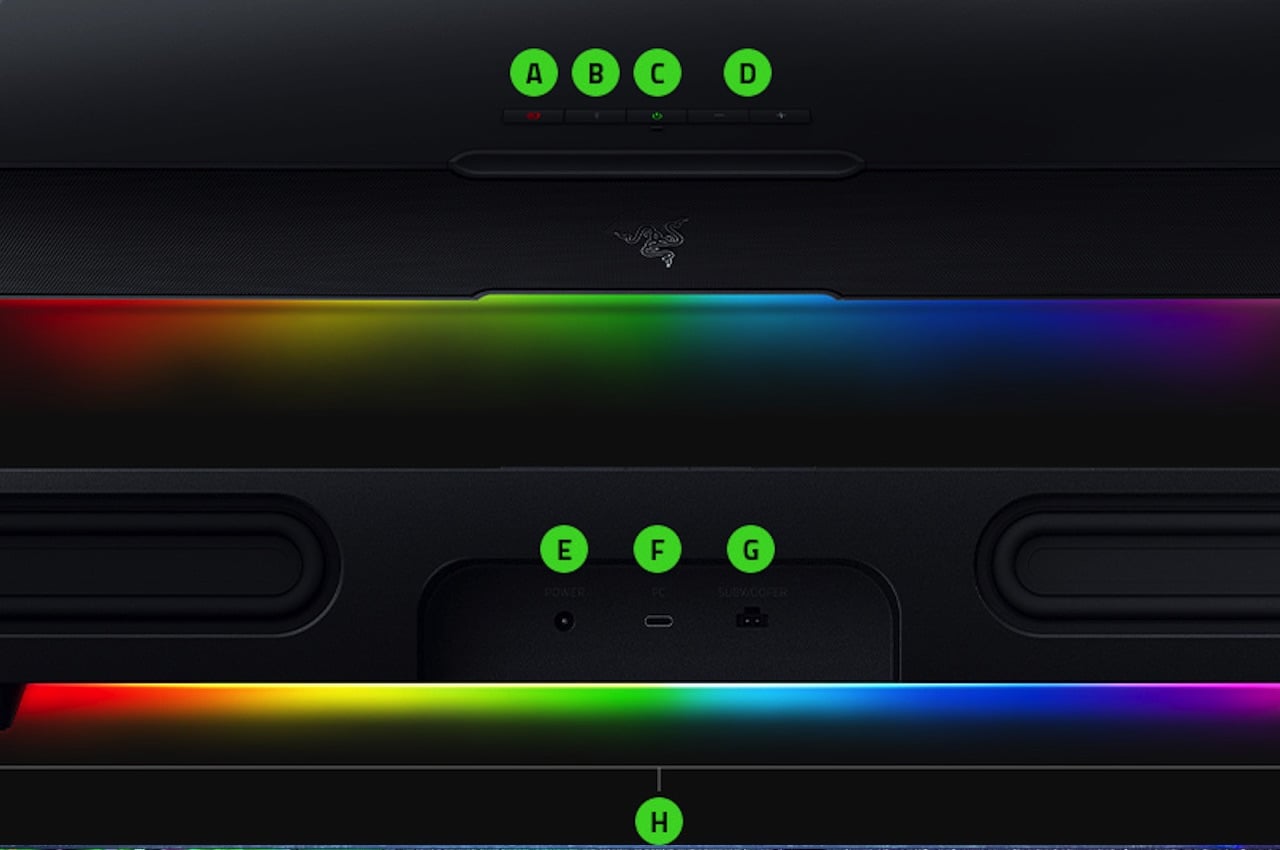
The Razer Leviathan V2 features Razer Chroma RGB and THX Spatial Audio. It also comes with low-latency Bluetooth 5. 2 for seamless and uninterrupted mobile and PC use. Expect deep bass and clear trebles as made possible by the down-firing subwoofer and two full-range drivers. This all-in-one system delivers a high quality audio experience, with full-range and high-fidelity sound.
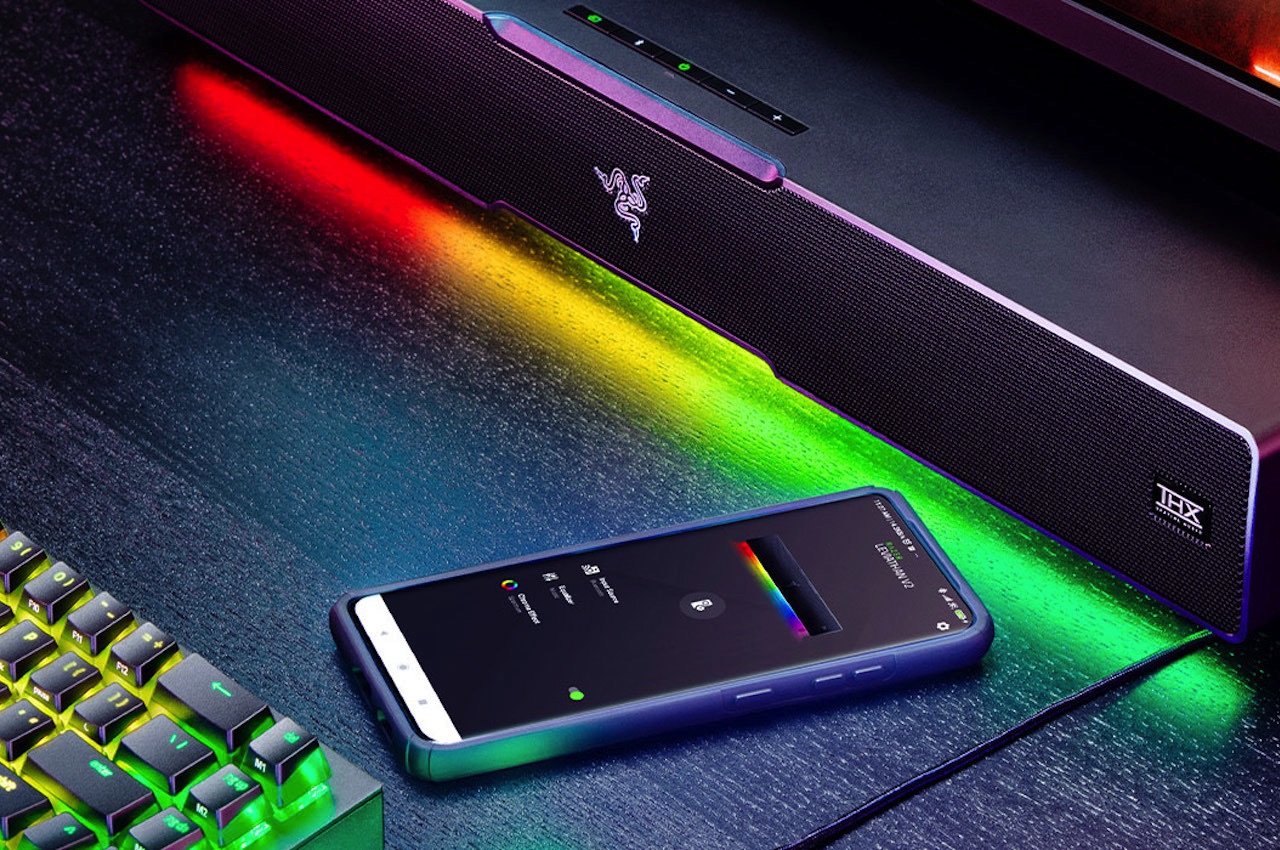
The Razer Leviathan V2 Soundbar delivers advanced 7. 1 surround sound with pinpoint accuracy. You will enjoy a more detailed soundstage when you watch movies or listen to music. Razer Synapse, compatible Razer mobile applications, allows you to customize your soundbar, RGB lighting and audio settings for a personalized experience. The software offers better and more control for your audio-listening experience. This allows you to enjoy the Razer speaker’s full potential by simply enabling the 360deg positional audio.
Design-wise, the new Razer soundbar boasts a very compact desktop form factor. Although it is small, the soundbar can still fill any room with great sound and has a very compact footprint. It doesn’t take up much space so it fits right under your monitor. It even has detachable rubber feet so you can adjust the angle or height.
Razer’s new Leviathan V2 Soundbar connects with most PCs via the USB Audio Input. In addition, it works with a Nintendo Switch and smartphones over Bluetooth connectivity. It features 18 lighting zones, dynamic in-game lighting effects, and numerous patterns for full RGB customization.
Razer is definitely a tech brand to monitor because it’s been offering the public exciting products and services. The company shows its passion for technology and design, as evident in the Razer Singapore headquarters. There is the Razer Sneki Snek x Caruma Sneakers plus the Razer all-in-one modular gaming desk.
We remember the Razer Kiyo Pro HD webcam as ideal for content creation, work-from-home, and streaming. The Razer Zephyr Face Mask delighted us with RGB lighting, while the Razer Stainless Steel reusable straw made sustainability sexy. Finally, the Razer Gaming Glasses were introduced with blue light blocking properties and built-in earphones.
Apple announces service program for Apple Watch Series 6 ‘blank screen issue’
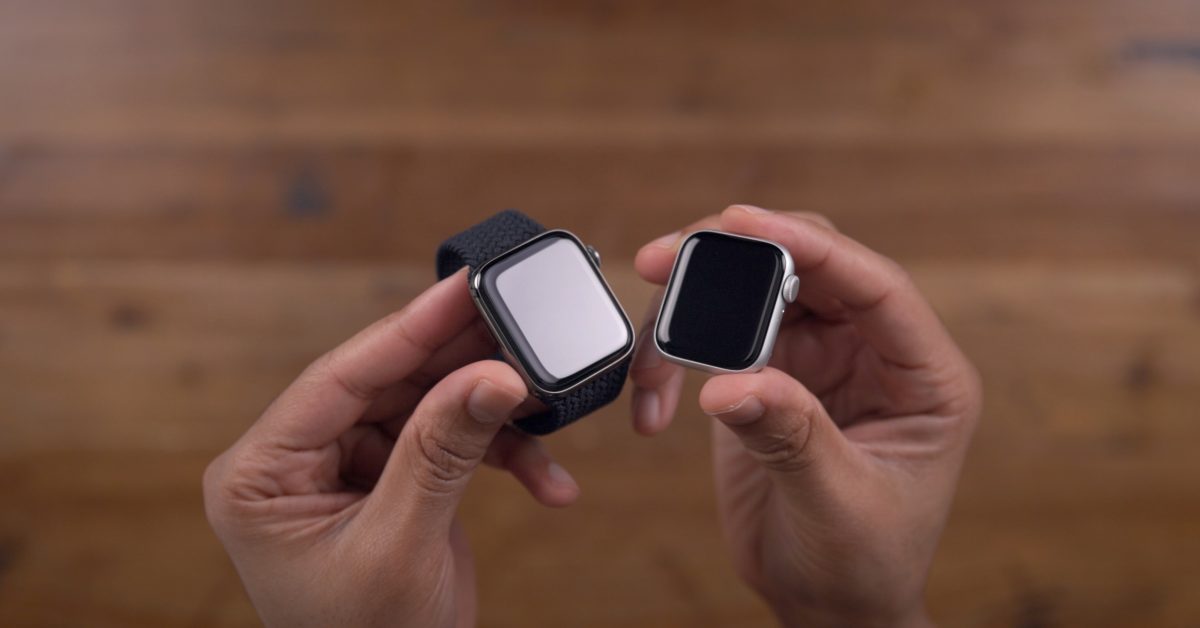
Apple on Friday announced a new service program for some Apple Watch Series 6 units that were affected by a “white screen issue.” Affected customers will be able to request a free repair through Apple or authorized service providers (AASP).
According to the company, only a small percentage of 40mm Apple Watch Series 6 models have been affected by this issue, which can cause the display to turn blank permanently. Apple says the affected units were manufactured between April and September 2021.
Affected customers can check if their Apple Watch Series 6 is eligible for repair by entering the serial number on Apple’s website. It’s worth noting that no other Apple Watch models except the 40mm Series 6 are part of this service program.
Apple has determined that the screen on a very small percentage of 40mm Apple Watch Series 6 devices may go blank permanently. Affected devices were manufactured between April 2021 to September 2021.
If your Apple Watch Series 6 has exhibited this issue, please use the serial number checker below to see if your device is eligible for this program. If so, Apple or an Apple Authorized Service Provider will provide service, free of charge.
If Apple’s website indicates that your Apple Watch Series 6 is eligible for repair, you should take it to an Apple Store or AASP. Except for damage to other components of the Apple Watch, the repair will be free.
The program covers eligible Series 6 Apple Watches for two years after the first retail sale of the unit, and it’s valid worldwide.
NLRB decision leads to historic Raven Software union vote
Raven Software’s quality assurance employees will vote, as a 21-person unit, on whether to unionize, the National Labor Relations Board ruled on Friday. The decision comes after Raven’s owner, Activision Blizzard, challenged organization efforts and sought to make the entire 230-person studio vote on the union.
All eligible Raven Software QA workers will be mailed ballots on April 29, and the ballots will be counted on May 23, the NLRB said. Should a supermajority of eligible workers vote yes, their union, called Game Workers Alliance, will move into contract negotiations with Activision Blizzard.
Activision Blizzard and Raven Software QA workers have been awaiting a decision from the NLRB since a hearing in February. In testimony during that hearing, Raven Software management and workers were questioned on the studios’ restructuring, in January, as it applied to union-eligible workers.
A spokesperson for Activision Blizzard told Polygon that the company would review all options in relation to a possible appeal. The full statement is as follows:
While we respect the NLRB process, we are disappointed that a decision that could significantly impact the future of our entire studio will be made by fewer than 10% of our employees. We believe a direct relationship with team members is the best path to achieving individual and company goals. We are reviewing legal options regarding a potential appeal.
On social media, Raven Software QA workers expressed excitement over the OK to vote. In a tweet, the group thanked its supporters: “We’re so proud that the NLRB ruled our unit eligible to vote,” it wrote. “Thank you to everyone supporting our campaign since our initial strike up until this very moment! Time for democracy!”
We are so proud to announce that the NLRB ruled that our unit is eligible for election! We are grateful to all who supported our campaign from the very beginning, right up to this moment. Time for democracy! #WeAreRaven#WeAreGWA
— Game Workers Alliance #WeAreGWA (@WeAreGWA) April 22, 2022
Raven Software’s union push, in partnership with the Communication Workers of America (CWA), kicked off in January following an employee walkout after a group of Raven Software contract workers were told they would not be among the 500 employees converted to new full-time positions last year. The NLRB hearing regarding the union’s scope began shortly after Activision Blizzard refused to voluntarily recognize the group.
Since then, Activision Blizzard announced its intention to convert another 1,000 QA workers to full-time positions, increase their pay to $20 per hour, and allow QA workers access to bonuses and benefits. Raven Software QA workers were not offered the same pay raises at that time; Activision Blizzard claimed that was because of “legal obligations under the National Labor Relations Act.”
QA contract workers are frequently referred to as an unskilled group in the videogame industry. Activision Blizzard QA employees told Polygon in August that QA contract cycle systems made it difficult for them to progress or feel secure in their career. This was on top of their low salaries and constant crunch. The Raven workers’ victory on Friday is therefore a landmark decision, with the potential to influence the video game industry as a whole.
Microsoft is preparing to acquire Activision Blizzard in a $68. 7 billion deal that will be reviewed by government regulators. Activision chief executive Bobby Kotick, who has faced calls for resignation from Activision Blizzard workers and the press (including this outlet), will continue to lead the company, at least until the Microsoft deal is finalized.
Review: iPad Pro and Air get premium leather protection with Nomad’s Modern Case and Folio
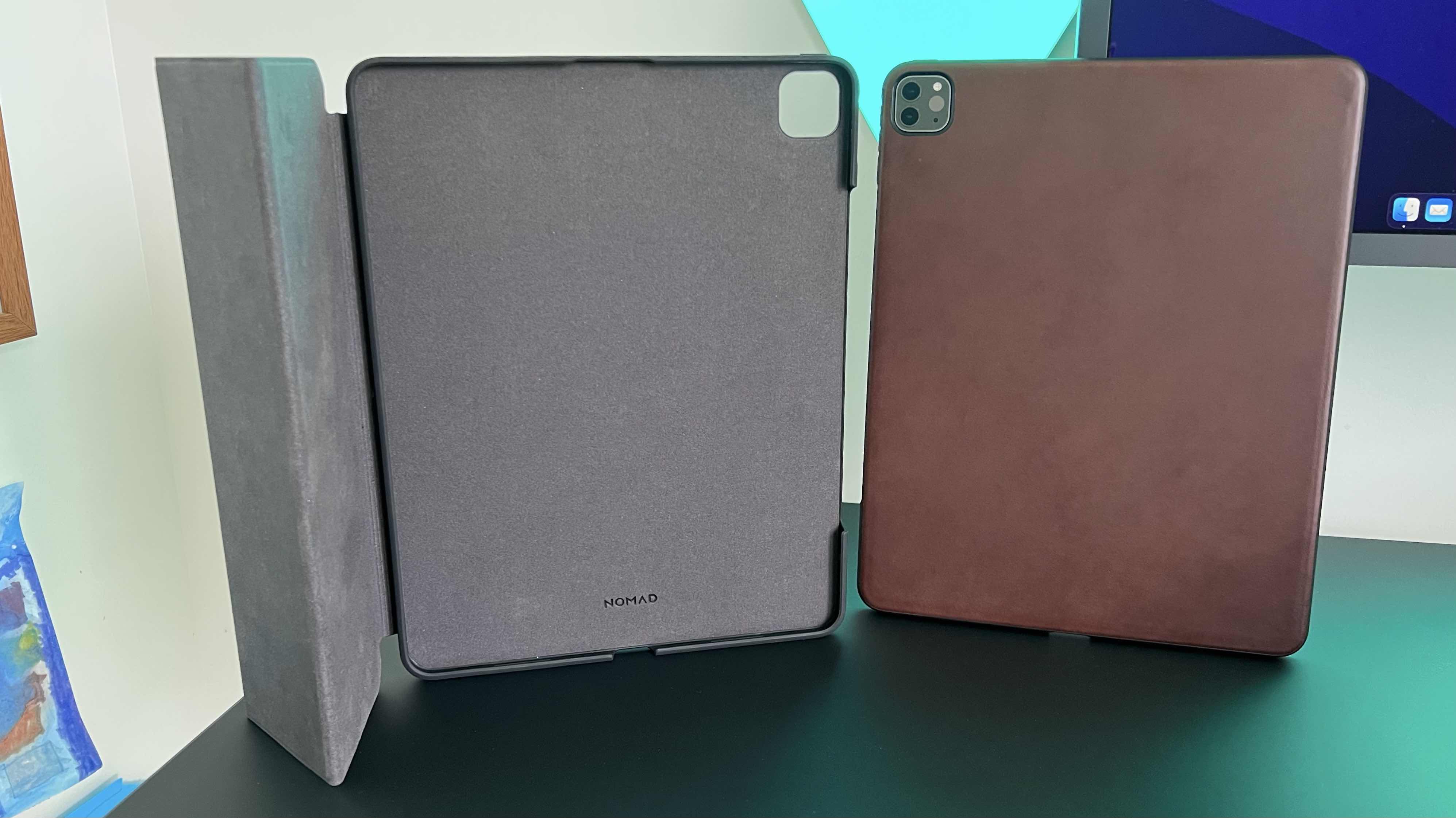
Nomad has launched its premium Modern Leather Case as well as Modern Leather Folio to fit the iPad Pro or Air. They are both minimalistic and lightweight, but still provide protection. Take a look at Nomad’s Modern iPad Leather Collection – two fantastic alternatives to plastic or silicone cases.
With Apple’s iPad Smart Folio only featuring silicone, and other companies using similar or more plastic, it is nice to have high-quality leather options by Nomad for iPad Pro and iPad Air.
Specs
Full-grain leather with high-grade polycarbonate core
Slim design
Protective thermoplastic elastomer (TPE) bumper
Folio features smart wake/sleep with magnetic closure and tri-fold stand
The iPad Modern Leather Case (and Folio) have been meticulously constructed and you will immediately notice the high-quality full-grain leather. It has a soft microfiber interior and blends effortlessly into the leather.
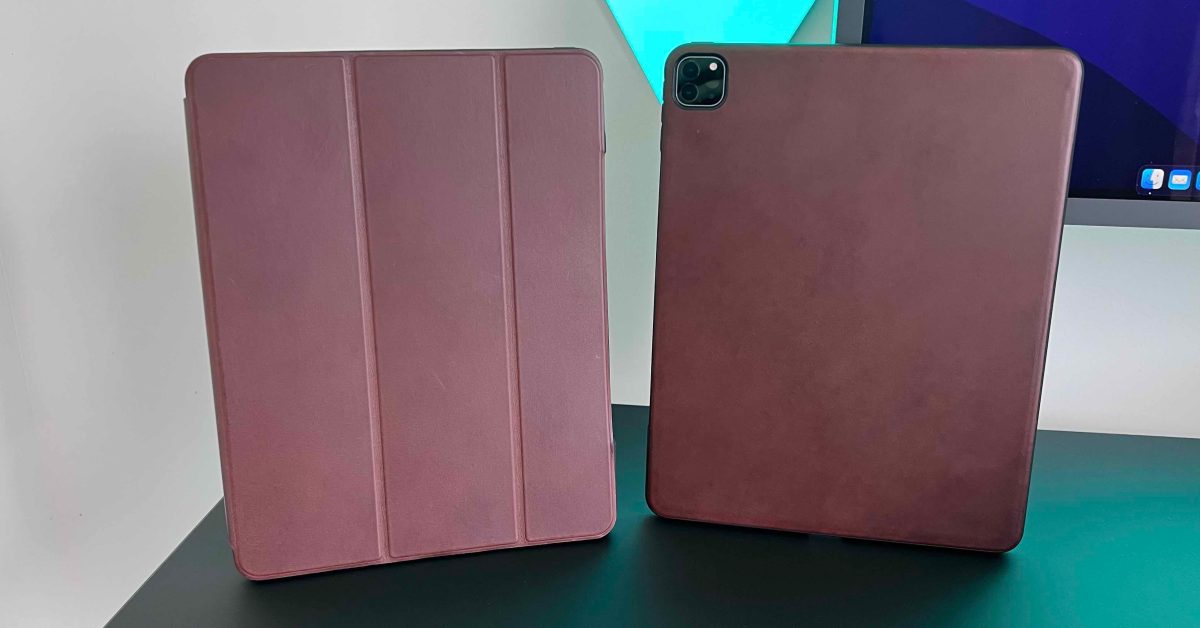
Nomad Modern Leather Folio on left, Modern Leather Case on right
The Modern Leather Folio and Case are available in rustic brown or black finishes and come with a two-year warranty.
In Use
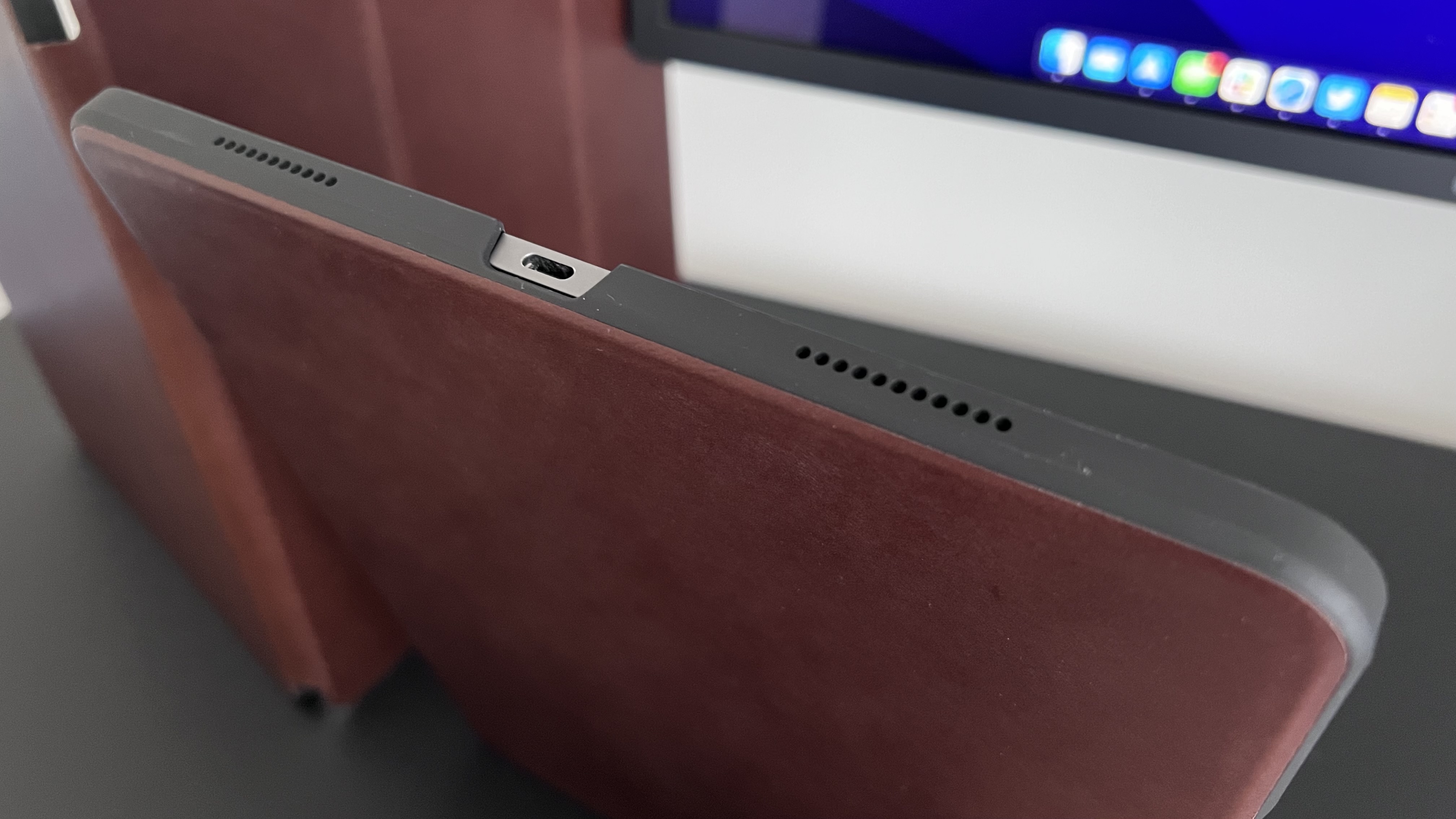
The precision of the Modern Leather Folio and Case really stood out to me. Everything from the speaker, mic, camera, and Apple Pencil cutouts to the super-smooth transition between the leather and TPE bumper, to the overall fit, is spot on.
I also think Nomad has struck a great balance between a slim design and keeping the iPad Modern Leather Case and Folio protective. Along with the polycarbonate core the leather is bonded to, the absorbent TPE bumper sits 1. 2mm above the screen so it’s protected even face down on surfaces.
The only piece of constructive criticism I can think of is it would have been neat to see Nomad use metal for the top and volume buttons as the TPE gives a squishy feel. But I understand that would likely be tricky to do with the TPE bumper.
Conclusion
This case and folio will naturally rule out a portion of customers with the $99/$149+ price points. But for those willing to invest the money for premium leather protection that will last for years, this iPad case and folio are easy to recommend.
Polygon’s Patch Notes is a weekly newsletter that tells you about the best stuff to watch, play, and read. Let our band of editorial experts simplify your plans — subscribe here!
Video game and tech culture has long been obsessed with “generations.” We mark milestones with new consoles or the numbers on an iPhone. It’s a helpful way to measure progress that moves at an unpredictable pace.
Once a year, Polygon expands this fixation on generations to explore the next generation of everything.
This is our favourite annual project, as it rewards from procrastination. So we wait to publish until the month before, so we can share stories about emerging streams of pop culture. These could be raging rivers that redirect the flow of global entertainment. This isn’t speculative fiction about a time 50 years from now; it’s a hint at where the world will be trending next month or next year.
These are only a handful of stories that we believe you will love. We recommend you check out the entire package.
This week on YouTube | The Super Mario Bros. movie is famously bad — so bad it killed the hopes of any good video game movie adaptations for YEARS. So they claim. But what if Super Mario Bros. wasn’t actually that bad? Jenna Stoeber explores the history and criticisms of the Super Mario Bros . film. You might even want to see it.
Six stories to read
Image: Marvel Studios
The MCU’s future lies with those it previously neglected: teen girls | “The future of the Marvel Cinematic Universe lies in Disney’s ability to gain the loyalty of the most progressive and skeptical generation yet, and there is only one ‘safe,’ new axis of diversity for Marvel Studios to lean into: women.”
TikTok and Instagram tags are changing how people cook | Four chefs and cookbook authors on how tagging influences recipe development.
The MCU broke up with Natalie Portman, but Taika Waititi won her back| Disney released the first trailer for Thor: Love and Thunder, and we got our first look at Natalie Portman as a superhero. This is how Jane Foster, got her godly powers .
The director of Bad Guys explains how animators are resisting “boring” CGI.
Moon Knight is finally fun| It took a beat, but Moon Knight is finding its groove. In its most successful episode, the MCU series is full Tomb Raider. Is the MCU willing to go even wilder?
A huge week for D&D | It’s been a big week for the Dungeons & Dragons brand, which hosted its first Nintendo-style streaming event called D&D Direct on Thursday. Spelljammer, Dragonlance and two other beloved settings are back. What’s the cherry on top? Wizards of the Coast tapped the designers of Pandemic Legacy and HeroQuest to team up for a D&D-themed board game.
Six things to watch
Photo: Aidan Monaghan/Focus Features
The Northman in theaters | Guys bein’ dudes! Gore galore! Here’s how they pulled off the awesome “spear shot” that’s all over the trailers.
The Unbearable Weight of Massive Talent in theaters | 2021 was an even wilder year than usual for Nicolas Cage. He won’t let that stop him from going even harder in 2022.
Petite Maman in theaters | The sweetest, subtlest science fiction film in years.
The Bad Guys in theaters | A lively mashup of Zootopia, Wreck-It Ralph, and decades of crime movies.
We’re All Going to the World’s Fair in theaters | Creepypasta fans finally get the exact movie they need.
Marvelous and the Black Hole in theaters | We spoke with director Kate Tsang about how her time on Steven Universe: Future and Adventure Time: Distant Lands informed her live-action debut.
Plus, everything new to streaming: 16 witchy movies! 16 great thrillers!
Three games to play
Image: GameTomo
Sumire | Over at Uppercut Crit, Monti Velez reviewed Sumire, a beautifully illustrated game about choices and grief. Available on Windows PC, iOS, and Switch.
Tiny Tina’s Wonderlands| More of us have reached the endgame of the Borderlands spinoff. Deep into the shooter, we discovered what makes it so fun: It can easily become a John Wick power fantasy. Available on PlayStation 4, Xbox One, PlayStation 5, Xbox Series X/S, and Windows PC.
Playdate| We previewed the Playdate last summer and were mostly charmed by the novelhandheld with a crank, though we wondered how games would work on the final model. Fortunately, the incomparable Christian Donlan at Eurogamer penned an excellent review to celebrate the Playdate’s official release along with a bundle of exclusive indie titles. At Polygon, be sure to read Ben Bertoli’s behind-the-scenes reporting on Playdate’s eight-year road to reality. Available at Play.date.
Free game of the week
Image: Frictional Games
Amnesia: Rebirth | The sequel to the tremendously popular Amnesia: The Dark Descent got a little lost upon release in October 2020. Blame the hype for the launch of new video game consoles or the series’ reputation for being extremely scary. Whatever the case, the thriller will hopefully find new fans with its free week on EGS. Available for free on Epic Games Store until April 28, 2022.
Lego is making an Atari 2600 to celebrate the console’s anniversary
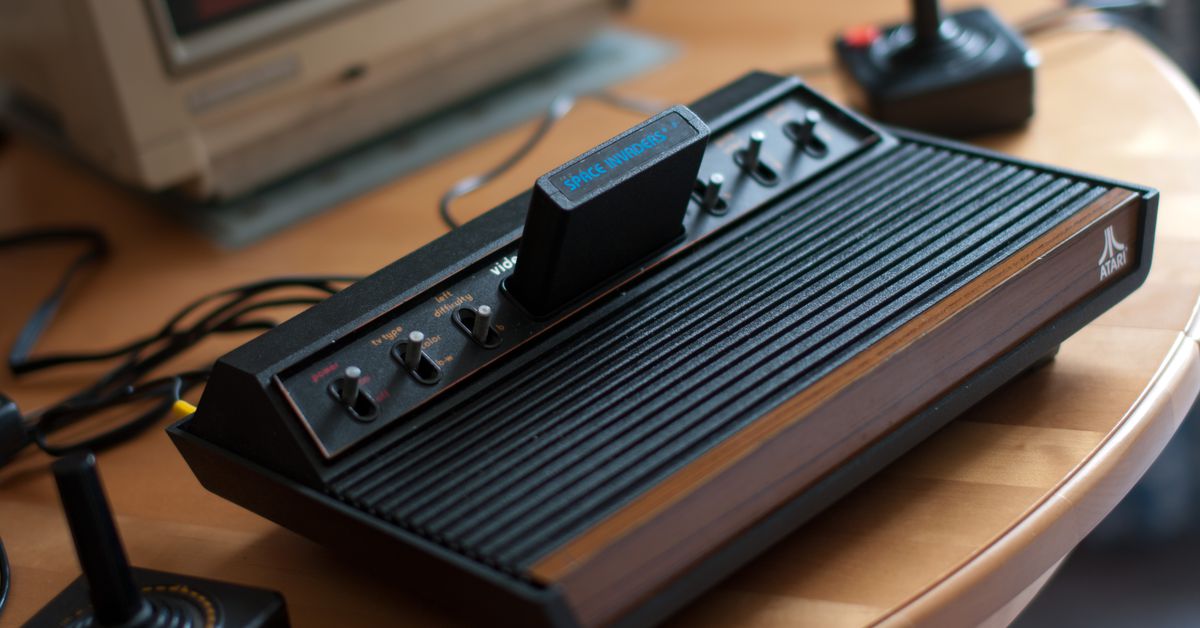
The Atari 2600 — in its familiar, wood-paneled, super-groovy late-1970s incarnation — will get a celebratory Lego-styled build this August in recognition of the console’s 40th/45th anniversaries (see below), according to German Lego fan site Promobricks.
According to Promobricks (translation via Google), the playset will feature a buildable Atari VCS deck, with a scene from Activision’s seminal hit Pitfall!. Pitfall!, by David Crane, was video gaming’s first third-party, made-for-consoles blockbuster.
Pitfall! launched in 1982, the same year that Atari rebranded the VCS (so, there’s your 40th anniversary) as the 2600. The console originally launched in 1977 (there’s the 45th). That came five years after Allan Alcorn and Nolan Bushnell installed the first PONG coin-operated cabinet at a bar in Sunnyvale, California (a 50th anniversary, for good measure).
Promobricks suggested that the fold-out scene of Pitfall! should be movable, using the playset’s joystick replica. In 2020, Lego launched a commemorative Nintendo Entertainment System brickset, which included a nearly life-size representation of the console, a Super Mario Bros.Game Pak, and an adorable, wooden-legged TV (with analog dials and rabbit-ear antenna) as a monitor. Builders could scroll Mario through a representation of World 1-1 by turning a crank on the side of the assembled TV.
The Lego Atari 2600 has set number 10306 (Atari 50th Anniversary Gaming Console) and will sell for $199.99 (€169.99), says Promobricks. Interestingly, that price (US) is about $10 more, in whole dollars, than the Atari VCS’ original MSRP when it launched in 1977. Of course, $189.95 in Jimmy Carter money is about $900 today.
Samsung wants to get in on the Apple M2 chip production
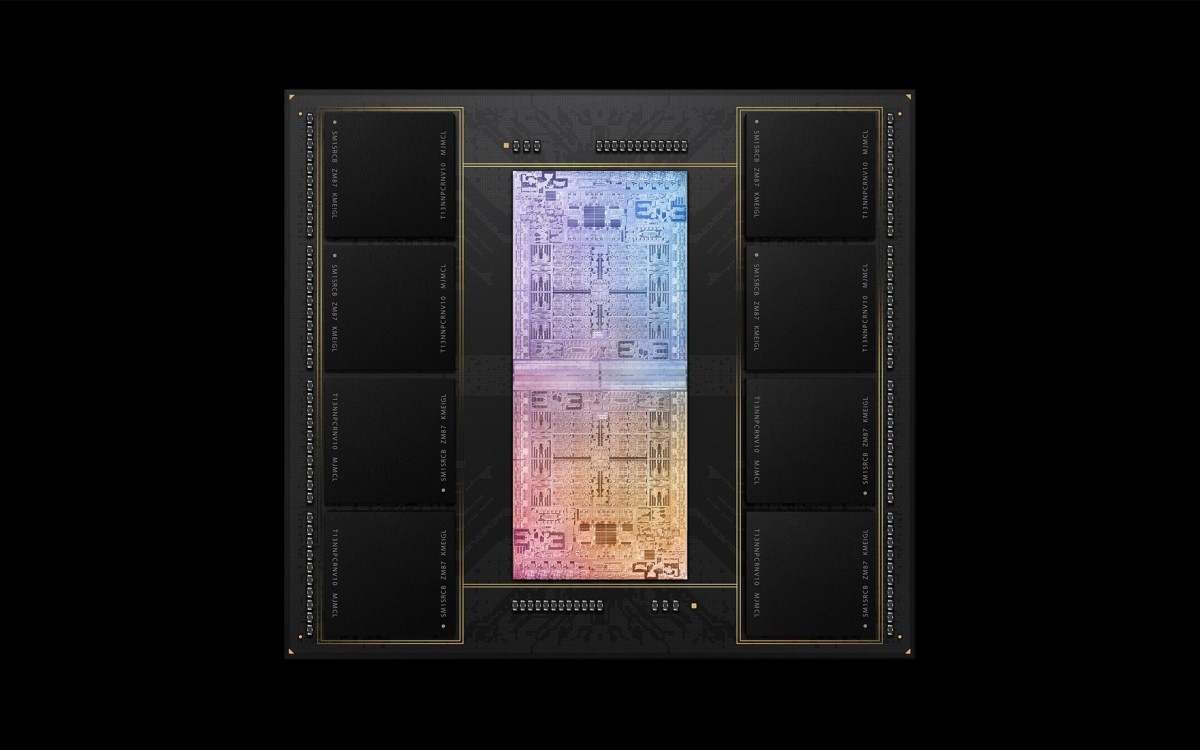
Apple’s current M1 silicon is used in its MacBook, Mac and iPad lineup so the company needs quite a bit of those chips. By extension, this means that whoever gets in on Apple’s M1 chip supply chain is up for some serious financial gains.
Samsung is one of those suppliers for Apple and is producing FC-BGA substrates that are crucial for modern high-density chips with circuit connections. Naturally, the Korean tech giant wants in on the M2 chip production as well.
The so-called Samsung Electro-Mechanics arm is pretty close to striking a deal with Apple to produce the same FC-BGA substrates for the upcoming M2 chip. This report coincides with recent intel of Samsung investing more than $1 billion in building an FC-BGA production facility in Vietnam and has invested over $241 million more into an already existing fab in South Korea.
Pokemon Go may help with depression, according to a study
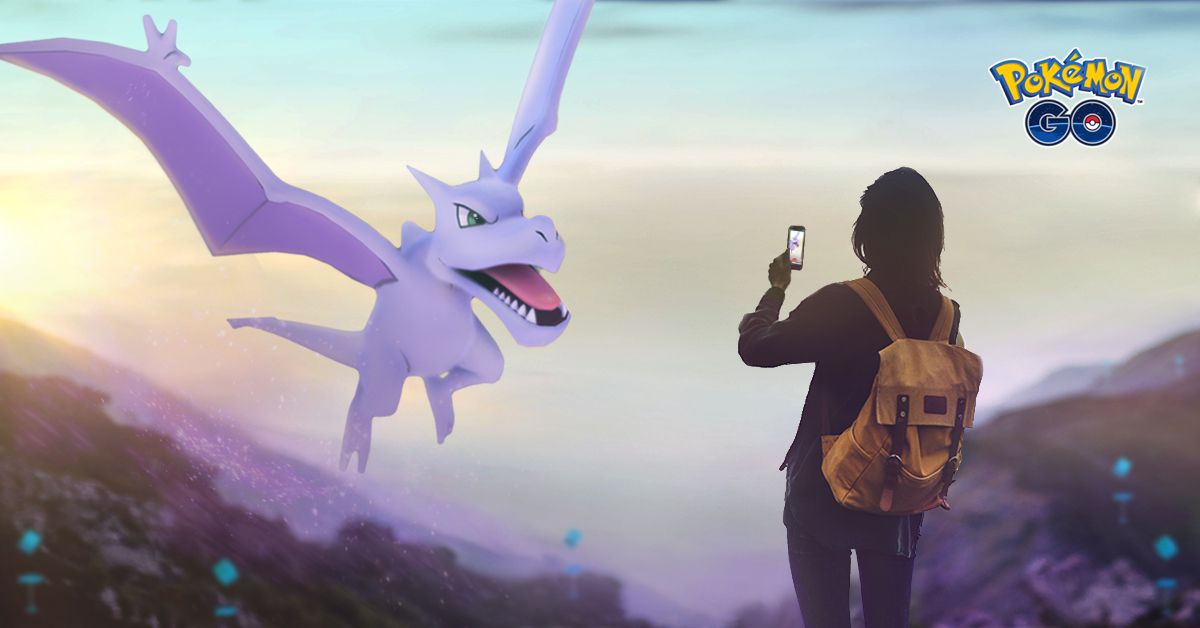
Pokemon Go might alleviate mild depression symptoms, it turns out. The London School of Economics and Political Science has published a new study titled “Location Based Mobile Gaming and Local Depression Trends” PokemonGo “. It argues that PokemonGo may help users with mild depression. This is because the game encourages socialization and physical activity. The Gamer first covered this study.
The study was published in Journal of Management Information Systems. It measures regional depression by using “well-established mechanisms from the medical and social health literature, internet searches of depression-related words,” to determine how many people are searching for terms such as “depression,” stress, anxiety, and fatigue in a particular region.
The data covers 166 different regions, 15 of which are in English-speaking countries, and spans a period of 50 weeks between January 1, 2016, and December 12, 2016. (Those dates include a time period that covers before and after Pokemon Go‘s release.)
Pokemon Go is a mobile augmented-reality game from Niantic in which you can battle and catch Pokemon based on your location. While the developers altered the game because of the Covid-19 pandemic, it largely requires you to actually get out and take a walk to collect Pokemon and battle with them at virtual gyms. Other features of the game, like Community Days, where certain Pokemon appear more often, further encourage players to get outside and perhaps meet other players during the event. These factors may help to reduce depression symptoms, according to the study.
If you want to connect and play with other trainers, Polygon has a complete list of PokemonGo Community Day for 2022..
T-Mobile breached by cybercrime group LAPSUS$ through compromised employee accounts
T-Mobile has suffered another data breach, this time carried out by young hackers that were part of the LAPSUS$ group. T-Mobile claims that there was no breach of customer information or government data. However, LAPSUS$ appears to have gained access both to T-Mobile’s source codes repositories and its customer management system.
Reported and seen by Krebs on Security (via TechCrunch), leaked messages between members in the LAPSUS$ cybercrime group show that they successfully hacked into T-Mobile multiple times last month.
The hackers gained access to T-Mobile’s internal systems by taking over multiple employee accounts with purchases through sites like “Russian Market,” social engineering, and other methods of stealing the information.
The messages reveal that each time LAPSUS$ was cut off from a T-Mobile employee’s account — either because the employee tried to log in or change their password — they would just find or buy another set of T-Mobile VPN credentials. T-Mobile currently has approximately 75,000 employees worldwide.
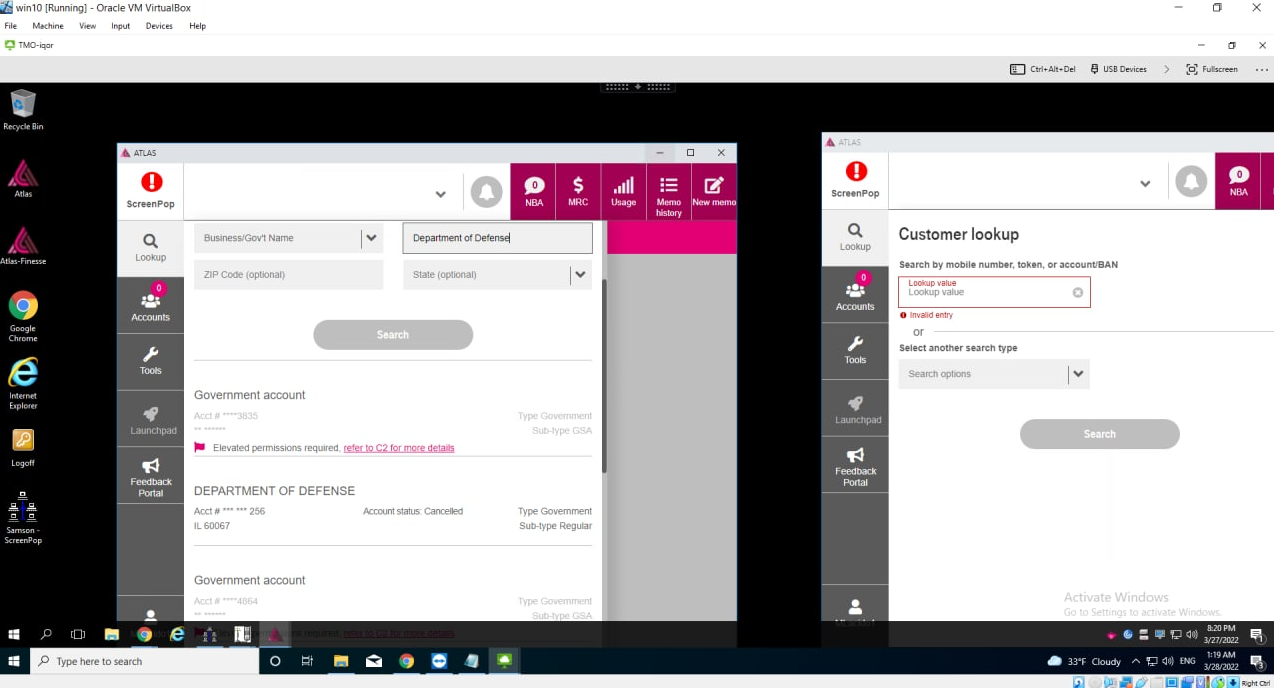
The LAPSUS$ chats and screenshots show they hacked into T-Mobile’s Atlas customer management system on March 19 and searched for “accounts associated with the FBI and Department of Defense.” But as it turned out LAPSUS$ didn’t have the additional credentials to access that information.
While some of the LAPSUS$ members “desperately wanted to SIM swap some wealthy targets for money,” their 17-year-old leader “White” decided to throw away the VPN access to the Atlas system and pivoted to exploring T-Mobile’s Bitbucket and Slack accounts.
About 12 hours later, “White” shared screenshots showing a script he created had downloaded over 30,000 of T-Mobile’s source code repositories which included content on a variety of the carrier’s projects.
In response to the LAPSUS$ hack, T-Mobile shared the following statement to Krebs on Security:
Several weeks ago our monitoring tools identified a bad actor who used stolen credentials to gain access to internal systems which house software for operational tools. We have no evidence the intruder obtained any customer, government or similar sensitive information. Our systems and processes worked as designed, the intrusion was rapidly shut down and closed off, and the compromised credentials used were rendered obsolete.
As for why LAPSUS$ decided to focus on T-Mobile source code instead of making malicious SIM swaps, Krebs on Security thinks they could have been looking for greater security flaws, already had buyers for the source code lined up, or it was potentially just “one big Capture the Flag competition.”
The most active members of LAPSUS$ were detained shortly after T-Mobile’s breach.
A look back at the evolution of iPhone hardware with GRID frames [Gallery]
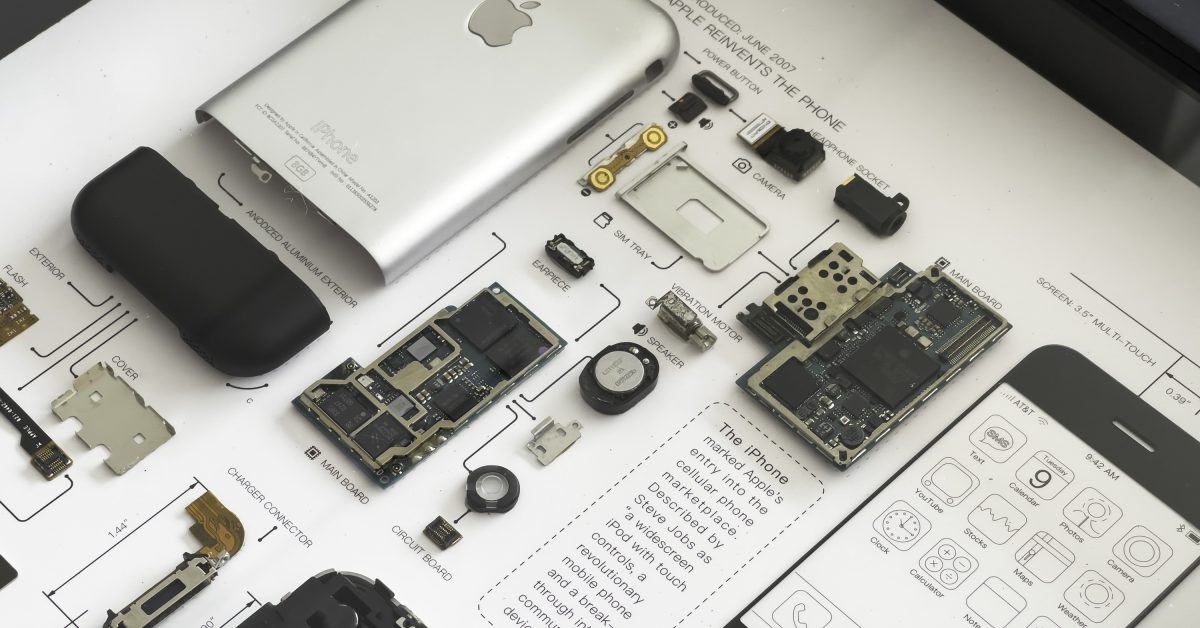
It has been 14 years since the first iPhone was introduced by Steve Jobs, and a lot has changed since then. Each generation of the iPhone has brought unique advances that are sometimes hard to notice, but that have made a difference when we look back at the past. And that’s what I did with GRID frames.
Update: To celebrate Earth Day, GRID is offering a special 20% discount on all its frames. Use the coupon EARTH2022 when ordering to get the discount. The offer is valid only for April 22, 2022.
I have always loved understanding how things are made behind what we see and use every day, like the code and hardware that makes it all work. Earlier this year, I discovered GRID, a company that sells disassembled electronics in frames. I even wrote about GRID 4S here on 9to5Mac:
As someone who really likes technology (and Apple, of course), I was looking for some related decorations for my home — and then I met GRID 4S, which is literally a piece with a disassembled iPhone 4s that you can put anywhere you want.
GRID is a company that has been selling framed electronic products for some time, and they all seem pretty cool. For Apple fans, they have pieces with the iPhone 3GS, iPhone 4s, iPhone 5, and the second-generation iPod touch.
After getting the iPhone 4s frame, I had to complete my collection with other models. Seeing how the iPhone has evolved over all these years was nice, but being able to look at all the hardware evolution right in front of me is even more amazing — which is why I wanted to share this gallery with our readers.
iPhone 2G
Who doesn’t remember the moment when Jobs first unveiled the iPhone in January 2007? That was an iconic moment that changed everything. And although I never had the iPhone 2G (also known as the iPhone Classic), that product made me want to go all in on the Apple ecosystem (and I ended up getting the first iPod touch that year).
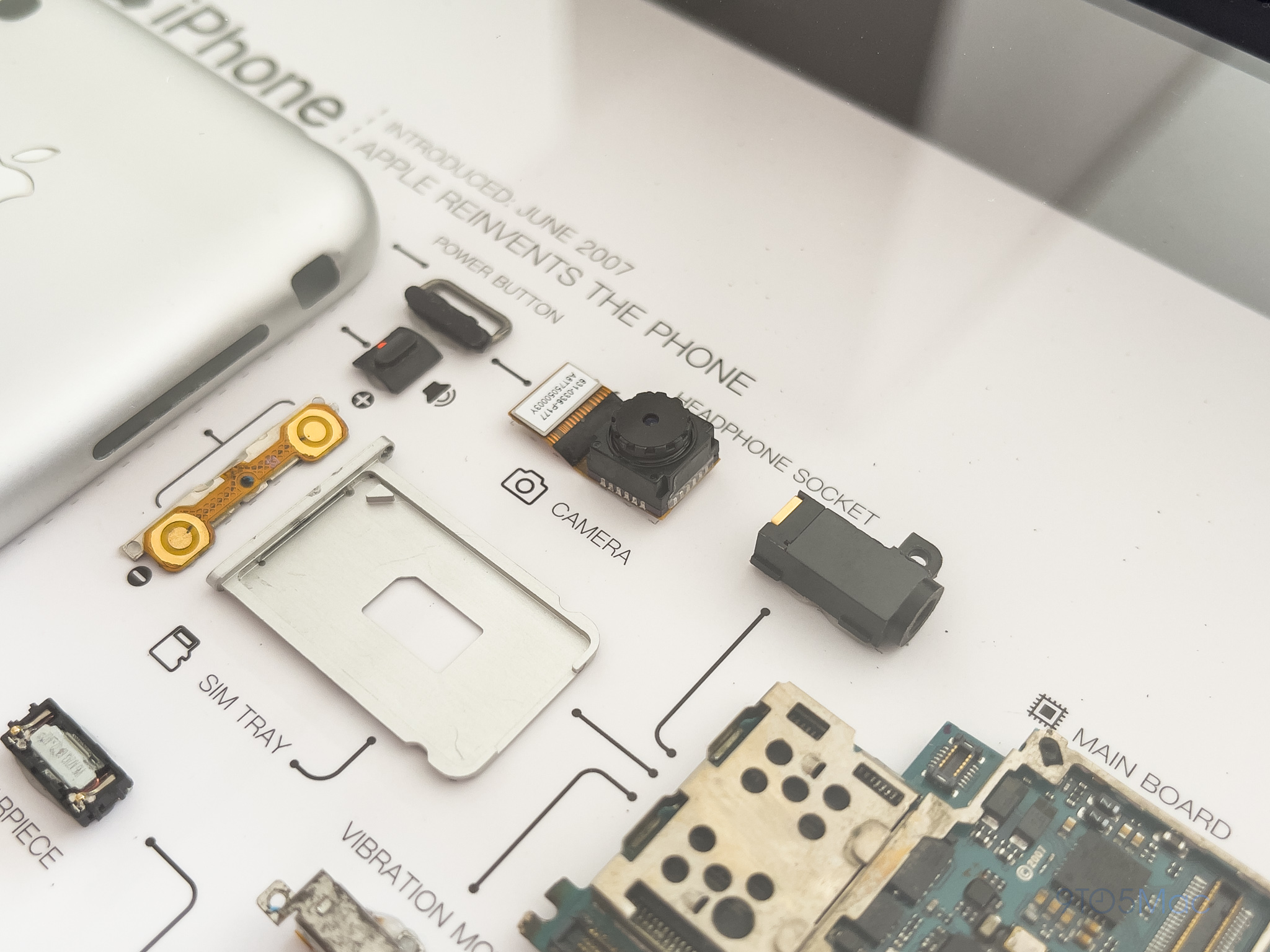
The construction of this iPhone may seem simple by today’s standards, but it was far more sophisticated than other smartphones of the time. The iPhone 2G body was made almost entirely of aluminum, but with a plastic bottom part to enable cellular and Wi-Fi signals.
This iPhone already had a built-in rear camera, but the quality was really low. Its sensor — with a really low aperture — captures 2MP photos, and it cannot shoot video. Also, it has no focus adjustment.
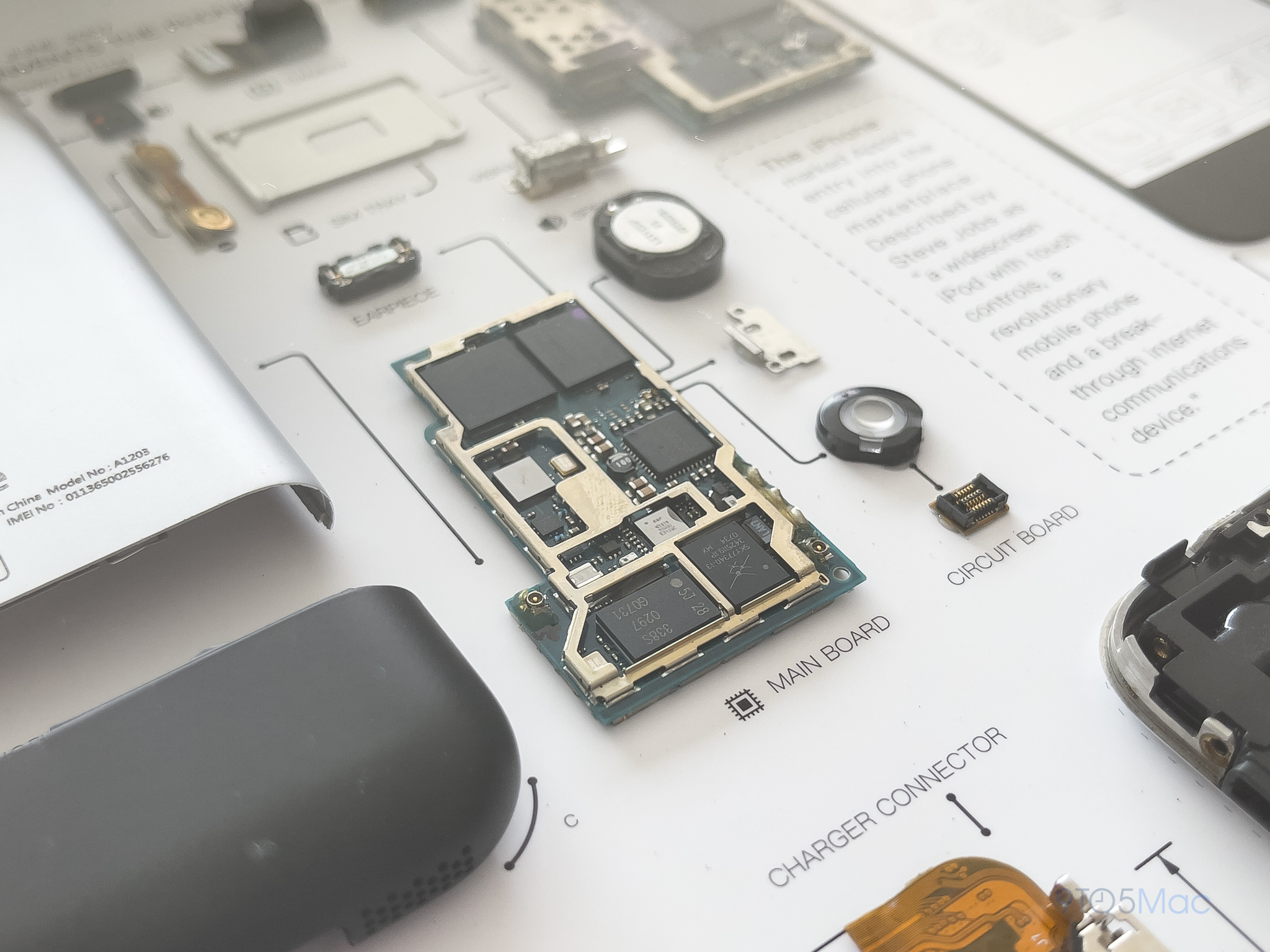
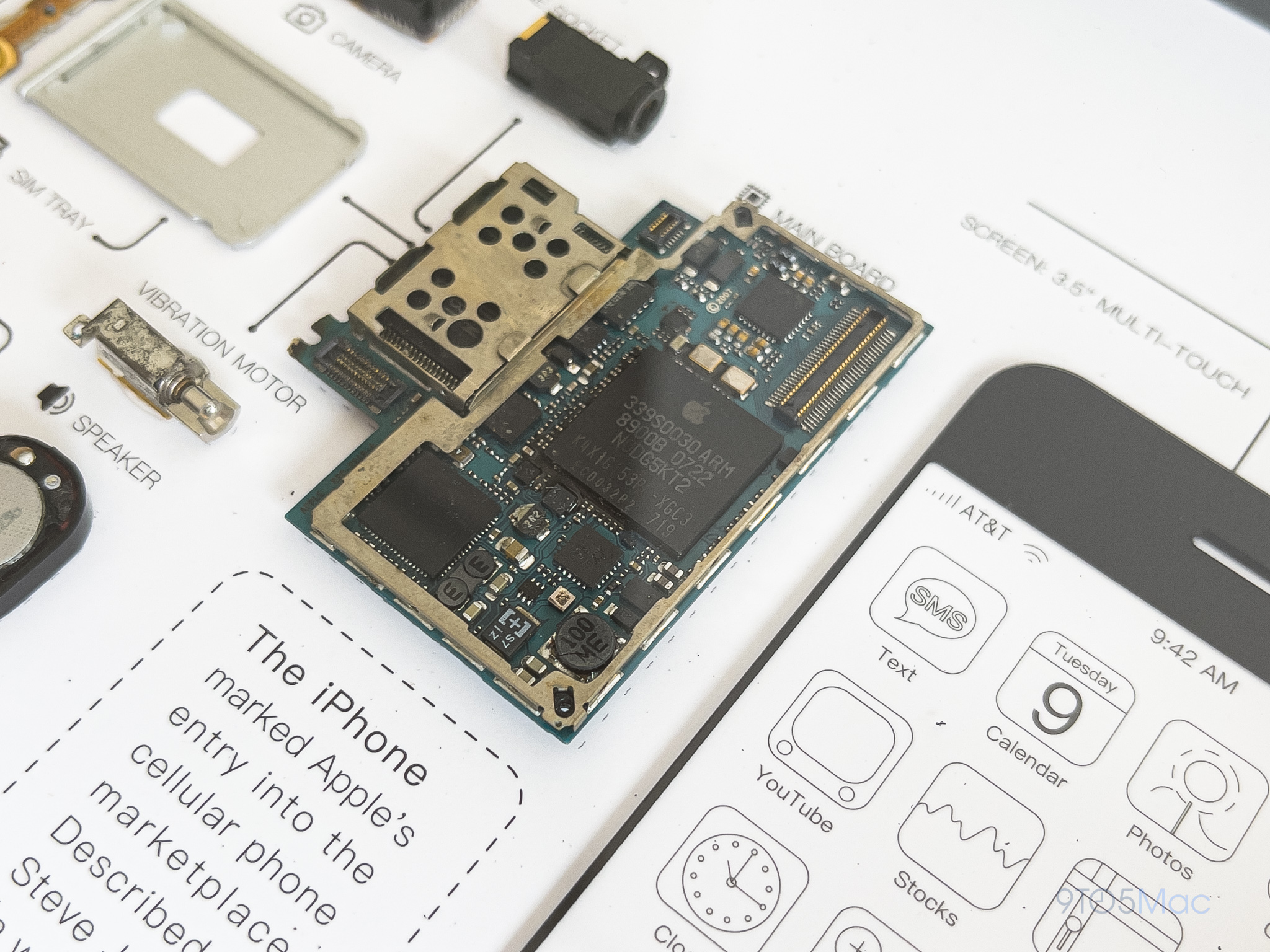
The logic board was split into two parts, and it relies on a Samsung ARM processor since Apple hadn’t yet developed its own Apple Silicon at that time. Although the CPU has a single 620MHz core, Apple has lowered the clock to 412MHz in order to save battery life. There are also other things to note, such as the simplicity of components like the speakers and vibration motor.
As a gift, GRID included the 9to5Mac logo on a metal plate that made my unit even more unique.
iPhone 3GS
A year later, Apple completely redesigned the iPhone with iPhone 3G. It was the first model to support 3G networks, but there weren’t many other changes to its hardware (it even uses the same CPU as the iPhone 2G). However, iPhone 3GS came in 2009, keeping the same design but with more hardware improvements.
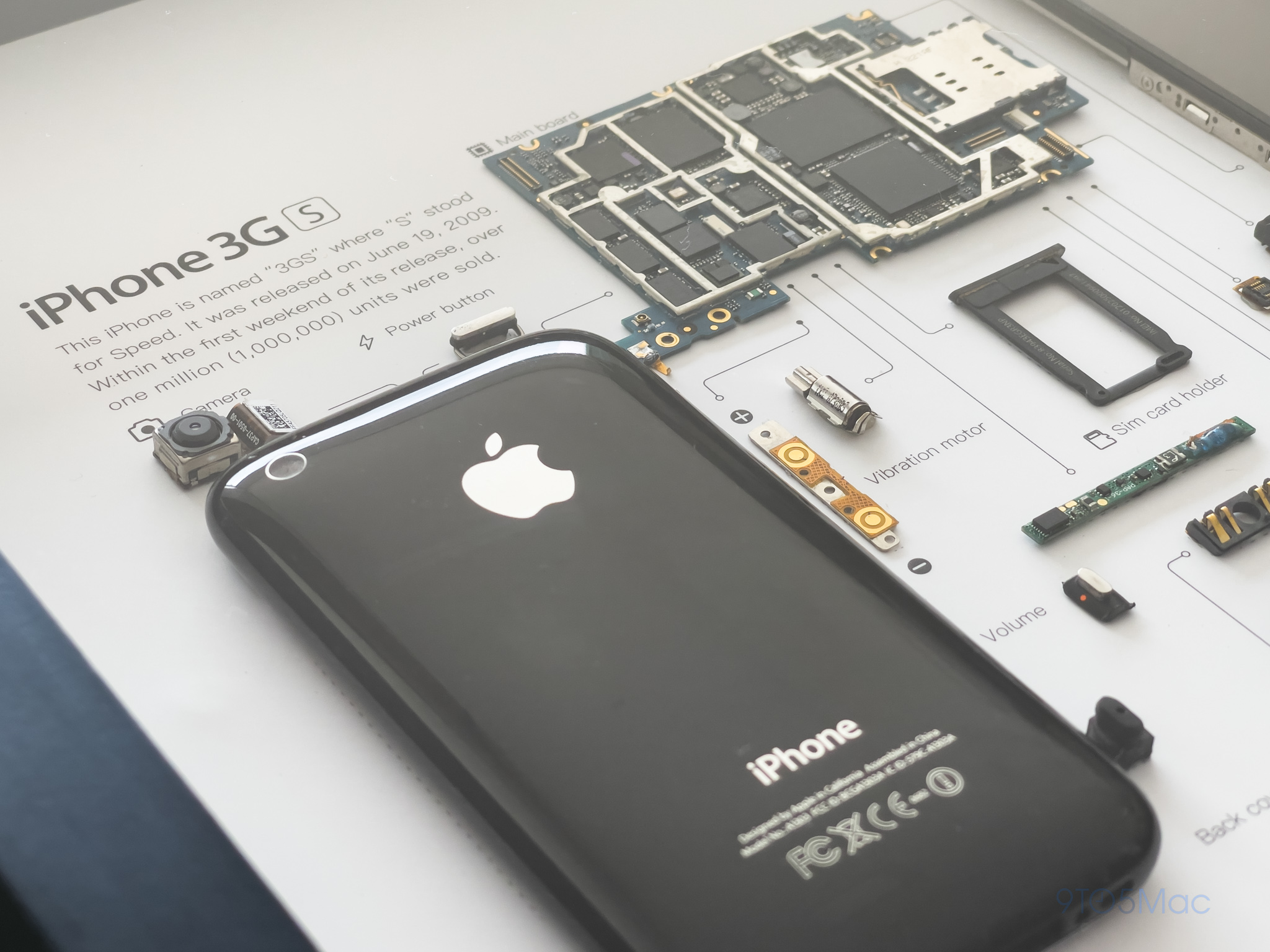
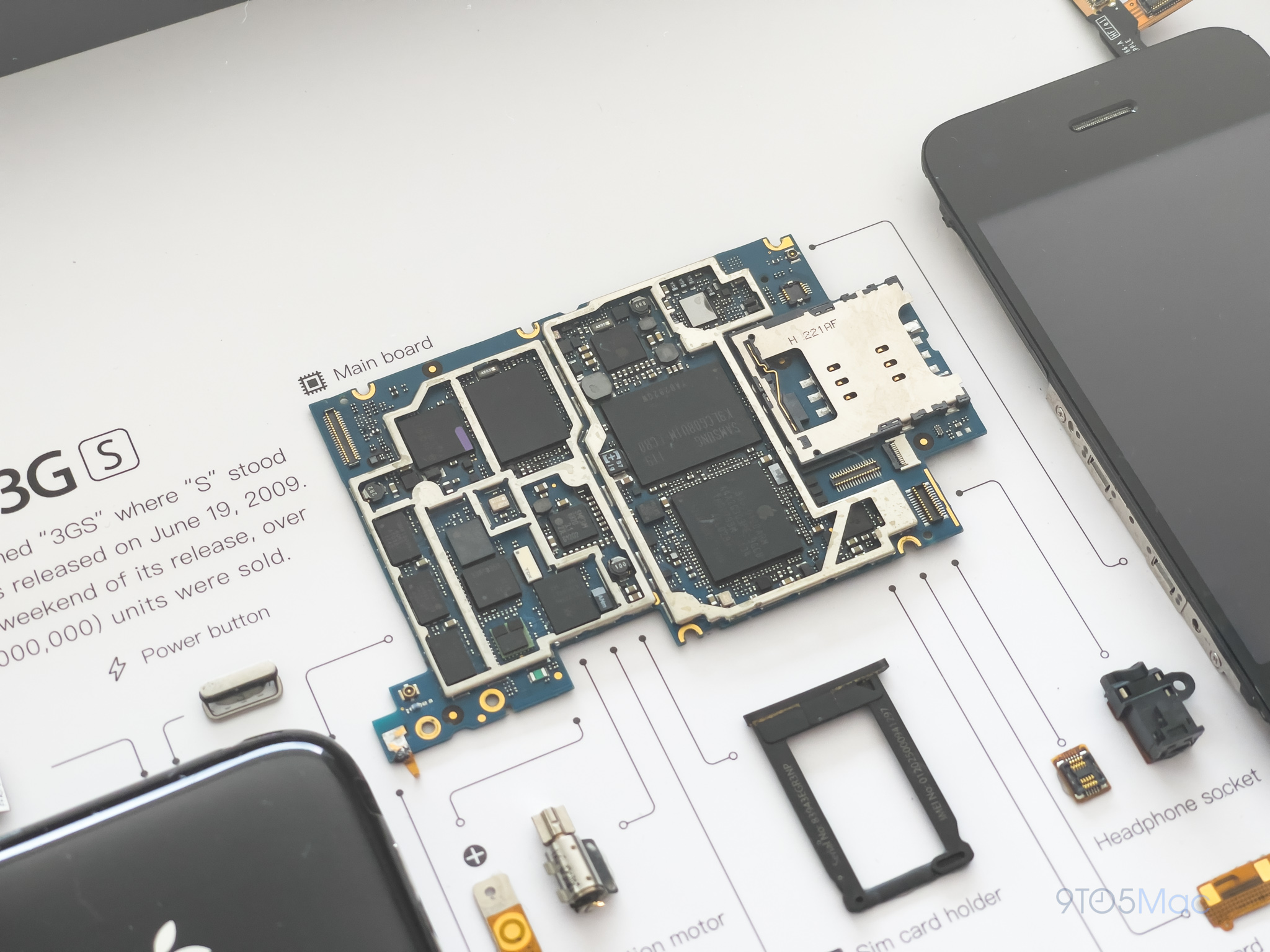
iPhone 3GS was announced at WWDC 2009 by Phil Schiller, as Steve Jobs had to leave Apple for a few months that year for a liver transplant. During the keynote, Schiller mentioned that the letter “S” stood for “speed,” since the iPhone 3GS was the first to have an upgraded processor and graphics. Also made by Samsung, this ARM processor is 600MHz.
Besides the shiny plastic back, we can notice that the iPhone 3GS camera is slightly different when compared to previous generations. Unlike its predecessors, iPhone 3GS had a 3MP sensor with adjustable focus that shoots 480p video.
It’s also cool to see how Apple brands its components, even the smaller ones like flex cables.
iPhone 4S
iPhone 4 in 2010 was the first major change to the iPhone since the original product. After a massive leak, iPhone 4 was introduced with a new glass design, Retina display, the first Apple-made A4 chip, and significant upgrades to the cameras.
In 2011, exactly a day before Steve Jobs passed away, iPhone 4S was announced at an event presented by Tim Cook, who had recently taken over as Apple’s CEO. The iPhone 4S followed the iPhone 3GS strategy of keeping the same design as the previous generation, but with more in-depth hardware improvements.
One of the main highlights was the A5 chip, the second version of Apple’s own ARM chip that was also the first dual-core chip in an iPhone. The performance of the iPhone 4S was noticeably better when compared to every other iPhone.
By looking at the camera module, it’s easy to guess that it’s much better than the cameras seen on previous iPhones. The sensor looks more advanced, as it now captures 8MP photos and, for the first time, 1080p video. It also has a small LED flash, which was introduced with iPhone 4.
The front camera was only 0.3MP, just like on the iPhone 4 (which was the first model to have one), but even so, it certainly provided amazing moments for many people on their first FaceTime calls or selfies taken with an iPhone. Look how small the front sensor is.
Overall, the internal design of the iPhone 4 and iPhone 4S is much more robust, and most components such as the buttons and flex cables seem more refined.
iPhone 6
Following the iPhone 5 and iPhone 5s, which both got a slightly larger screen, there’s the iPhone 6. I remember watching the Apple event in September 2014 and being super excited about the new iPhones, as they were much bigger than their predecessors.
iPhone 6 and iPhone 6 Plus had an all-new, more rounded design made entirely of aluminum, with the antennas embedded as plastic strips on their back. With a more compact logic board and more internal space, Apple was able to add bigger batteries to the iPhone 6 and 6 Plus (they still weren’t perfect, but much better than those in the iPhone 4 and iPhone 5).
The rear camera sensor was still 8MP, but it has more tricks. It was the first iPhone to be able to capture 1080p video at 60 frames per second, or 720p at 240 frames per second — which enabled super slow-motion. Users could capture photos while recording videos, and the autofocus became faster and more accurate. You can also see the True Tone LED flash in the photos.
Here the front camera was already 1.3MP with the ability to shoot video in 720p. In terms of performance, the A8 chip was still a dual-core processor, but now with 64-bit architecture (first introduced with the A7 chip in the iPhone 5s). The iPhone 6 still had a mechanical Home button, which was also the biometric reader.
iPhone 7
Finally, we get to the iPhone 7, which I consider the last iteration of the original iPhone form-factor before the iPhone X (excluding the iPhone 8 and iPhone SE). iPhone 7 was quite an upgrade with a refreshed look (including this gorgeous matte black version) and important enhancements.
Unlike the other iPhones, the Home button on the iPhone 7 is somewhat virtual. It is there, but it’s not a mechanical part since it works based on pressure sensors.
The four-core A10 Fusion chip was way ahead of the competition at the time, and it is still considered a great chip today. The “Fusion” name is due to the fact that this chip was the first with different cores for full performance and power efficiency.
The cameras on the iPhone 7 were quite advanced, with optical stabilization on all models for the first time. The larger 12MP sensor has an aperture of f/1.8 for capturing better photos in the dark, and it can record videos in 4K resolution. The front camera also had a giant leap with a 7MP sensor.
Components such as the Lightning port and the speakers have rubber protection, as the iPhone 7 was the first water-resistant iPhone. Speaking of speakers, look how much bigger the iPhone 7 earpiece is — that’s because it was also the first iPhone with stereo speakers. And I couldn’t forget Taptic Feedback, which is really cool to see that it looks exactly like Apple shows in its videos.
Looking ahead to the future
Nowadays, we have very different iPhones, with no Home button, much smaller chips, and advanced sensors for facial recognition. These, however, I’ll leave for another article in the future when we get to the next iteration of iPhone design.
If you also want to take a closer look at iPhone hardware or simply decorate your home with technology, check out GRID’s store to get these and other frames.

:format(webp):no_upscale()/cdn.vox-cdn.com/uploads/chorus_asset/file/23317434/ms_marvel_trailer.jpg)
:format(webp):no_upscale()/cdn.vox-cdn.com/uploads/chorus_asset/file/23381981/4179_D034_00452_R.jpg)
:format(webp):no_upscale()/cdn.vox-cdn.com/uploads/chorus_asset/file/23409845/ss_04937010a28cc44fa3207fc9bfcbfb8cf913966a.1920x1080.jpg)
:format(webp):no_upscale()/cdn.vox-cdn.com/uploads/chorus_asset/file/21971679/amnesia_rebirth_rift.png)
:format(webp):no_upscale()/cdn.vox-cdn.com/uploads/chorus_asset/file/23404812/LIGHTYEAR_ONLINE_USE_lightyear_v1.pub16.jpg)