Apple Pay in Russia: Suspension of service leads to lawsuit against iPhone maker

Apple Pay in Russia: Suspension of service leads to lawsuit against iPhone maker

Apple Pay in Russia was last month suspended by the Cupertino company as one of a range of sanctions against the country for its invasion of Ukraine. A class action lawsuit has now been filed against Apple, arguing that Russian consumers have been harmed by losing access to the electronic wallet service.

Russian citizens who have been affected by the withdrawal of Apple Pay in the country are being invited to join the case …


Background

Apple Pay service in the country was suspended back in February as part of US sanctions against five Russian banks.

Following Russia’s invasion of Ukraine, the US government and the European Union imposed economic sanctions on the country – which include restricting foreign transactions to Russian banks. As a result, Apple Pay, Google Pay, and other digital wallets have been suspended in Russia […]

The affected banks are: VTB Group, Sovcombank, Novikombank, Promsvyazbank, and Otkritie. The Central Bank of Russia notes that cards issued by these five banks no longer work with Apple Pay or Google Pay, as both platforms are US-based.

Shortly afterwards, Apple halted all sales in Russia’s online Apple Store, and ceased supplying all Apple products to resellers in the country.

Lawsuit over suspension of Apple Pay in Russia

RepublicWorld reports on the lawsuit.

Lawyers from Chernyshov, Lukoyanov and Partners (CLP) law firm have decided to file a case against Apple for closing its payment service Apple Pay on devices in Russia […]

Konstantin Lukoyanov told TASS that the law firm has decided to sue Apple as the rights of Russian consumers have been violated by the “unjustified” and “unilateral” shutdown of Apple Pay.

According to the attorney, the move by the company needs to be considered as “intentional moral damage” to Russian users and owners of Apple devices. The attorney asserted that the recovery amount needs to be substantial for compensating the damage caused to the Russian consumers by the decision of Apple […]

Anyone who thinks that their rights were violated by Apple’s decision and it needs to be held “responsible” for its actions, can contact the law firm and join the lawsuit against the company. 

9to5Mac’s Take

The lawsuit seems unlikely to succeed, even in Russia, as the suspension of Apple Pay is a direct consequence of US government sanctions against Russian banks. In other words, Apple couldn’t legally offer service there even if it wanted to.

It is an unfortunate fact that innocent Russian citizens are suffering in many ways as a result of sanctions, but the loss of Apple Pay hardly ranks among the significant ones – and the remedy is in the hands of Putin, not Apple.

https://i0.wp.com/9to5mac.com/wp-content/uploads/sites/6/2022/04/Lawsuit-over-suspension-of-Apple-Pay-in-Russia.jpg?resize=1200%2C628&quality=82&strip=all&ssl=1

Spelljammer confirmed with a new D&D campaign book due out this August

Spelljammer confirmed with a new D&D campaign book due out this August

Spelljammer is returning to Dungeons & Dragons. This setting combines high fantasy with space travel. Wizards of the Coast announced the setting’s return Thursday during the D&D Direct streaming presentation. The three-volume set, titled Spelljammer: Adventures in Space, comes packaged in its own slipcase, and includes a double-sided map and a Dungeon Master’s Screen. Pre-orders appear to be live now on Amazon with a list price of $69.99. August is the release date. 16.

Spelljammer was first introduced in 1989, also as a boxed set titled Spelljammer: Adventures in Space written by Jeff Grubb. It was originally published by TSR. Physical copies are still available through a partnership with OneBookShelf.

The setting’s name comes from the eponymous starships. These are large flying craft controlled by wizards. You can see one in action in the teaser trailer above. Spelljammers look like elegant, open-decked vessels with distinctive, wing-like sails used to travel through space, through the air of terrestrial planets, and even between different planes of existence. They have been connected to the various settings in the D&D multiverse including Eberron and The Forgotten Realms.

The Astral Adventurer’s Guide . is the first volume in Spelljammer : Adventures in Space . Wizards says it contains everything DMs need to run a campaign as well as six new options for playable characters — specifically all six of the races included in recently released playtest materials. That includes the industrious autognome, the bipedal hippo-like giff, the primate-like hadozee, the oozy plasmoids, astral elves, and the insectile thri-kreen.

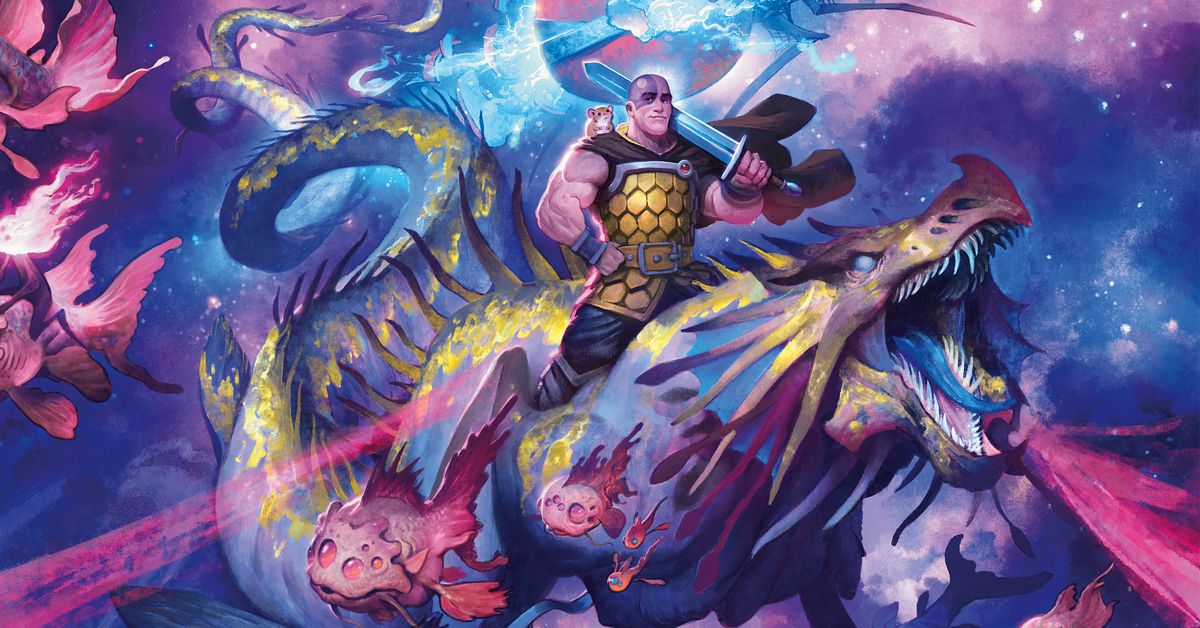
The second book is titled Boo’s Astral Menagerie, named after the eponymous miniature giant space hamster from the original Baldur’s Gate video game. This is where the strangest part begins: The setting now features evil space clowns and vampirates as well as sentient comets and space dragons.

The final book in the series is Light of Xaryxis .. Set in Wildspace in the Astral Sea, it includes 12 episodes, each of which end in a cliffhanger. It’s not known at this time what levels characters will start or finish the adventure at.

This slipcase-packed collection is not the first Wizards have released. Mordenkainen’s Monsters of the Multiverse was released as part of a three-volume set earlier this year. The books included with Spelljammer: Adventures in Space are, however, much slimmer at just 64 pages each. Previously released hardcover materials for 5th edition D&D are generally well in excess of 250 pages each.


https://cdn.vox-cdn.com/thumbor/GFMCw_lEM_F4h9VjL2BrK1L_S3s=/0x215:3000×1786/fit-in/1200×630/cdn.vox-cdn.com/uploads/chorus_asset/file/23404612/Boos_Astral_Menagerie__Art_by_Justin_Gerard_copy.jpg
Categories
Uncategorized Uncategorized Uncategorized Uncategorized Uncategorized Uncategorized Uncategorized Uncategorized Uncategorized

Apple’s lobbying spend hits record high as company resists antitrust pressure

Apple’s lobbying spend hits record high as company resists antitrust pressure

Apple’s lobbying spend hit a new quarterly record high in the first quarter of this year, as the company continues its efforts to fight antitrust measures.

Apple is feeling particular pressure from bipartisan support for both the Open App Markets Act and the American Innovation and Choice Online Act …


Background

Apple faces antitrust charges on a number of fronts. We last month outlined the background to just one of the antitrust threats to Apple.

2019 saw the start of a year-long investigation into whether tech giants were guilty of anti-competitive behavior. Apple was one of the companies investigated, with Tim Cook required to testify before Congress – and was among the tech companies found to engage in “deeply disturbing” anticompetitive behavior.

Congress was initially expected to try to pass a single antitrust bill to tackle all of the issues identified, but instead for multiple bills. We’re currently up to six of these, one of which had been described as putting the entire Apple ecosystem at risk

If passed into law, it would impact Apple’s treatment of apps like Spotify, but some have suggested it could even bar the company from pre-installing its own apps on iPhones.

The American Innovation and Choice Online Act has made the most progress. Apple CEO Tim Cook personally lobbied against the bill, but his concerns were dismissed by co-sponsor Senator Amy Klobuchar. The bill had bipartisan support in the Senate Judiciary Committee, but it faces opposition from some in both houses […]

The Department of Justice has now thrown its weight behind the bill, arguing that it would enhance its ability to challenge anti-competitive behavior.

Apple’s lobbying spend hits record high

Bloomberg reports that Apple is now spending more than ever on lobbying efforts, which are primarily geared to fighting antitrust issues.

Apple Inc. spent a record quarterly high of $2.5 million on lobbying in the first three months of 2022 amid increased pressure from the U.S. Congress on technology companies over antitrust issues.

Apple’s lobbying expenditures increased more than 34% from the $1.86 million the company spent in the fourth quarter of 2021, according to disclosure reports released Wednesday. The previous high was $2.2 million, spent in the second quarter of 2017.

Google, which faces many of the same charges as Apple, spent even more, at $2.96M.

Photo: Sasun Bughdaryan/Unsplash

https://i0.wp.com/9to5mac.com/wp-content/uploads/sites/6/2022/04/Apples-lobbying-spend-hits-record-high-this-year.jpg?resize=1200%2C628&quality=82&strip=all&ssl=1

The vivo X80 series will introduce a new Sony IMX866 RGBW sensor

The vivo X80 series will introduce a new Sony IMX866 RGBW sensor

vivo already confirmed that the X80 flagship series will bring the improved V1+ ISP, which will be paired with either a Dimensity 9000 or a Snapdragon 8 Gen 1 chipset for the different models. Either way, this new chip will process image data from a new sensor – the launch of the X80 series will mark the world debut of the Sony IMX866.


The vivo X80 series will introduce the improved V1+ ISP chip

The vivo X80 series will introduce the improved V1+ ISP chip

The IMX766, which was used in the vivo X70 generation, has a fairly standard Quad Bayer filter. The IMX866 is switching to an RGBW filter, which will capture more light and will be supported by custom image processing algorithms on the V1+. The IMX866 will be roughly the same size as its predecessor, 1/1.5” optical format (vs. 1/1.56”), no word on the resolution yet.


The vivo X80 series will be the first to feature the Sony IMX866 RGBW sensor

The vivo X80 series will be the first to feature the Sony IMX866 RGBW sensor

The X80 phones will also feature a camera with gimbal stabilization. Another camera will have an advanced 7-element lens. Adding to that, all cameras will benefit from the Zeiss T* anti-reflective coating.

Teaser images for the vivo X80 also make a mention of a 1/1.3” GNV sensor from Samsung, the “V” signifying a custom version made for vivo specifically. Presumably, that will go in the main camera of the X80 Pro+, while the X80 Pro will use the IMX866. This was the case with the X70 generation where the Pro+ used the GN1 (also 1/1.3″), the Pro got the IMX766 (1/1.56″).


A look at the vivo X80 design, which hints at a custom ISOCELL GNV sensor (1/1.3

A look at the vivo X80 design, which hints at a custom ISOCELL GNV sensor (1/1.3″)

The vivo X80 series will be unveiled on April 25 (Monday), so we’ll get the full picture next week.

Source (in Chinese) | Via

https://fdn.gsmarena.com/imgroot/news/22/04/vivo-x80-imx866/-952x498w6/gsmarena_000.jpg
Categories
Uncategorized

Outriders’ new Worldslayer expansion coming later this summer

Outriders’ new Worldslayer expansion coming later this summer

Last year, Outriders surprised players with its surprisingly deep customization system and ability-focused combat. Toward the end of 2021, developer People Can Fly launched a small content update, New Horizon, and revealed a new expansion, Worldslayer, coming June 30.

In a livestream on Thursday, People Can Fly offered the first concrete details on the upcoming expansion, which we played a short demo of in late March. Unlike the New Horizon update, Worldslayer is a paid expansion for Outriders, and won’t come to Game Pass — although it seems the base game will remain a part of Microsoft’s subscription service.

Worldslayer should be pretty familiar to Outriders players, and there are no big-ticket items like a new class or weapon type (that we know of). Instead, Outriders‘ first expansion focuses on improving the solid base the game already had. That starts with difficulty, where the game’s various challenge tiers (difficulty levels that go up as you progress, offering better rewards) will now be Apocalypse tiers.

The first 15 Apocalypse tiers will be for all Outriders players, while the final 25 — up to tier 40 — will be exclusive to Worldslayer players. Of course, players who brave these higher tiers will be rewarded with higher-level gear (up to 75) and special “Apocalypse” items.

Two Outriders fight a boss on the ice

Image: People Can Fly/Square Enix

When an item drops in Worldslayer, it has a chance to drop as an Apocalypse item, which has an extra, third mod slot on it, further enhancing a player’s skills and offering more combinations than before. However, players will still only be able to swap out one of the now three potential mods on their armor, making god-rolled items that much harder to grab, but far more rewarding for players willing to put in the work. With each class also getting two new Legendary sets and numerous Legendary weapons, there will be some major build shakeups in Worldslayer.

Players will have two options to enhance their character: Ascension and PAX class tree.

The PAX tree class is a new skill tree that players can invest in using skill points from Worldslayer content. These trees give bonuses to classes that their kits are otherwise missing, and should allow players to either broaden their builds or specialize further.

The Ascension system should be familiar to Diablo or Borderlands players who’ve interacted with the Paragon or Badass rank systems, respectively. As Outriders continue to do their Outrider thing post-max level, they’ll be able to improve their stats with small, incremental upgrades. This is a very long-term system; People Can Fly says it could take around 360 hours for players to unlock every node.

For players who want to jump into Worldslayer but missed the original Outriders, the expansion will come with a level-30 boost, which players can use as many times as they want, and can even be used to boost other classes up to endgame levels.

An Outrider with a flaming Legendary gun

Image: People Can Fly/Square Enix

As for what these newly level 30 characters will be doing: Worldslayer will add several hours of campaign content, new areas, and more. People Can Fly is also promising a new endgame activity, which will get its own broadcast closer to the expansion’s launch date.

In our limited experience with Worldslayer, where we played about an hour of the new campaign in a three-player group, it’s definitely more Outriders. But that’s not the dis it may initially appear to be. I was a pretty big fan of Outriders last year, and it always felt like something that was close to greatness — a solid first draft that could come out swinging with a sequel or an expansion.

With the new character build depth in Outriders , not to mention mysterious endgame activities, the expansion could be the beginning of a new age for People Can Fly’s 3D shooter. In my demo, Outriders still felt great to play, and I was excited by every piece of Apocalypse gear that dropped for me and PAX points I could place in my new skill tree.

Regardless of whether the final product is more of the same or the improvement I’ve been hoping for since last year, Worldslayer definitely showed me enough to leave me excited about my return to Enoch.

https://cdn.vox-cdn.com/thumbor/sqFL1O79Q1dQ4E2joEYv76Rx4II=/0x75:3840×2085/fit-in/1200×630/cdn.vox-cdn.com/uploads/chorus_asset/file/23405765/Outriders_Worldslayer_4K_05.jpg

Apple’s transparency reports aren’t very transparent, says campaign group

Apple’s transparency reports aren’t very transparent, says campaign group

A campaign group has criticized Apple’s twice-yearly transparency reports, saying that in one very important respect they are not very transparent.

One section of the report covers App Store Takedown Requests, and Apple is accused of deliberately concealing information about the apps it removes …


Background

Apple publishes Transparency Reports twice a year. These detail the actions it has taken in response to both government and private data requests, as well as the apps it has removed from the App Store in response to takedown requests.

Apple provides information regarding requests from government authorities to remove apps from the App Store based on alleged/suspected violations of local law. Examples of such requests are where law enforcement or regulatory agencies suspect an app may be unlawful or relate to/contain unlawful content. Apple complies with these requests insofar as we are legally required to do so.

The latest report revealed that the majority of app takedown requests were received from China, and that Apple removed every single one of the apps concerned.

Apple reports that it received 39 legal violations takedown requests covering 206 applications. China accounted for 26 of those requests covering 90 applications, followed by India making six requests covering 102 applications. Apple removed all 206 of the applications requested.

Apple’s transparency reports aren’t, in fact, transparent, says campaign group

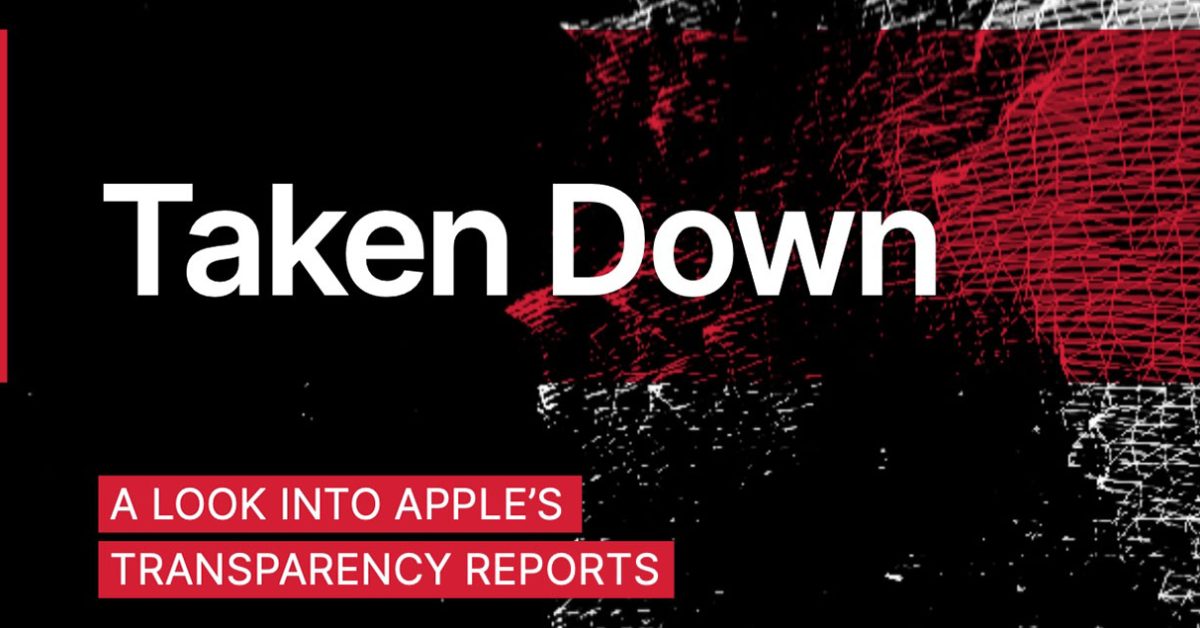
The accusation is made by GreatFire, a campaign group whose mission is to “monitor and challenge internet censorship in China.” The group has published its own report, titled “Taken Down: A Look into Apple’s Transparency Reports.”

Apple carefully engineered its Transparency Reports to conceal as much information as possible on app removals from the 175 App Stores it operates worldwide.

Dissecting the four Transparency Reports covering “Worldwide Government App Store Takedown Requests” from January 2019 until December 2020, AppleCensorship uncovered scores of missing data, incoherence and contradictory information presented in the most deceptive way, making it impossible for the public to have a clear understanding of Apple’s government-led and proactive removals of apps from its App Stores. In presenting such reports as its effort to be transparent to the public, Apple is deceiving its users and the public on the reality of its takedown policy, both in terms of its nature and true scale.

AppleCensorship’s report demonstrates that despite the publication of these so-called “transparency” reports; Apple is still operating in the most opaque way, unaccountable for the decisions it takes regarding certain content, information and tools unavailable on the App Store.

The group says that while Apple provides statistics, it fails to provide any of the information that would be required to assess the reasonableness of the app removals.

  • No information on the apps being removed, their category, the type of content, and functions they offered, and the App Stores in which they were present before being removed.
  • No information on government bodies issuing the takedown requests, the dates of requests, their legal basis, and the reasons invoked by these bodies for app removals.
  • Only 10 vague and shortly phrased reasons were used repeatedly by Apple to describe the reasons for app removals: “apps operating without government licence,” “illegal gambling,” and “illegal content” account for 32 out of the 41 brief explanations provided by Apple.

GreatFire says that this makes it impossible to know who was targeted or harmed by the removals.

Since no information is given on the apps being removed, it is impossible to know if certain groups of users (such as Human Rights activists, journalists, ethnic minorities or vulnerable communities such as LGBTQ+) have been targeted by such removal.

Additionally, it says that governments often make takedown requests by reporting apps as being in violation of App Store policies – which avoids the need for them to cite a legal basis for their removal.

Platform Policy Takedown Requests (PPVTR) trigger many more removals than Legal Violation Takedown Requests (LVTR).

Over two years, the 869 apps removed following LVTRs generated 948 removals worldwide, while the 191 apps removed for PPVTRs generated 29,605 removals worldwide. In other words, 96.90% of all removals were made following Apple’s own decisions. Only 3.10% of all removals were made because of Apple’s legal obligation to comply with local laws.

The group says that Apple should provide much more information, including the list of apps removed, and the laws the apps are alleged to have broken.

We’ve reached out to Apple for comment, and will update with any response.

https://i0.wp.com/9to5mac.com/wp-content/uploads/sites/6/2022/04/Apples-transparency-reports-arent-very-transparent.jpg?resize=1200%2C628&quality=82&strip=all&ssl=1

Garmin Vivosmart 5 is a new breed of fitness trackers with distress button and advanced sleep tracking

Garmin Vivosmart 5 is a new breed of fitness trackers with distress button and advanced sleep tracking

A smart fitness band on the wrist, connected to your smartphone, lets you take charge of your wellbeing. It monitors the health and helps you stay connected with instant notifications. Fitbit Charge 5 is arguably the best smart band on the market but it is likely to face fierce competition from the all-new Garmin Vivosmart 5.

Vivosmart 5 is a successor to the brand’s Vivosmart 4 fitness tracker launched in 2018. Four years since, there has been a considerable change in the sensors and features included in fitness trackers that present a more streamlined and affordable alternative to high-end smartwatches. Vivosmart 5 doesn’t choose to deviate much from the original idea of the Vivosmart 4, despite the lapse in time; yet it presents a decent competition to some of the top names on the block. There are a few reasons for this.

Designer: Garmin

It begins with the design. Designed for round-the-clock usage, “Vivosmart 5 is there when you need it, and unobstructed when you don’t.” Packaged in a sleeker form factor with easy to read, 66-percent larger OLED display (from the predecessor), the Vivosmart 5 is Garmin’s most advanced sleep tracking band that includes a sleep score feature. It provides information regarding the quantity and quality of a user’s sleep. Using the smart band, users can track heart rate, sleep, physical activity, and keep tabs on text messages & incoming calls. It is thus made for anyone who wants a simple solution for tracking their well-being and monitoring their oxygen levels and the body battery energy & stress levels throughout the day.


Keeping in perspective its advanced sleep tracking feature, the Vivosmart 5 is made for 24/7 wear. This is made convenient with the rounded band that allows the tracking device to fit snugly around the curves of the wrist. Essential to some adventurists, the new Garmin fitness tracker arrives with a physical button that triggers a safety message on a press. The button may not look too pleasing to the eye sitting right below the watch face, but its capability will definitely add to the Vivosmart 5’s selling point.

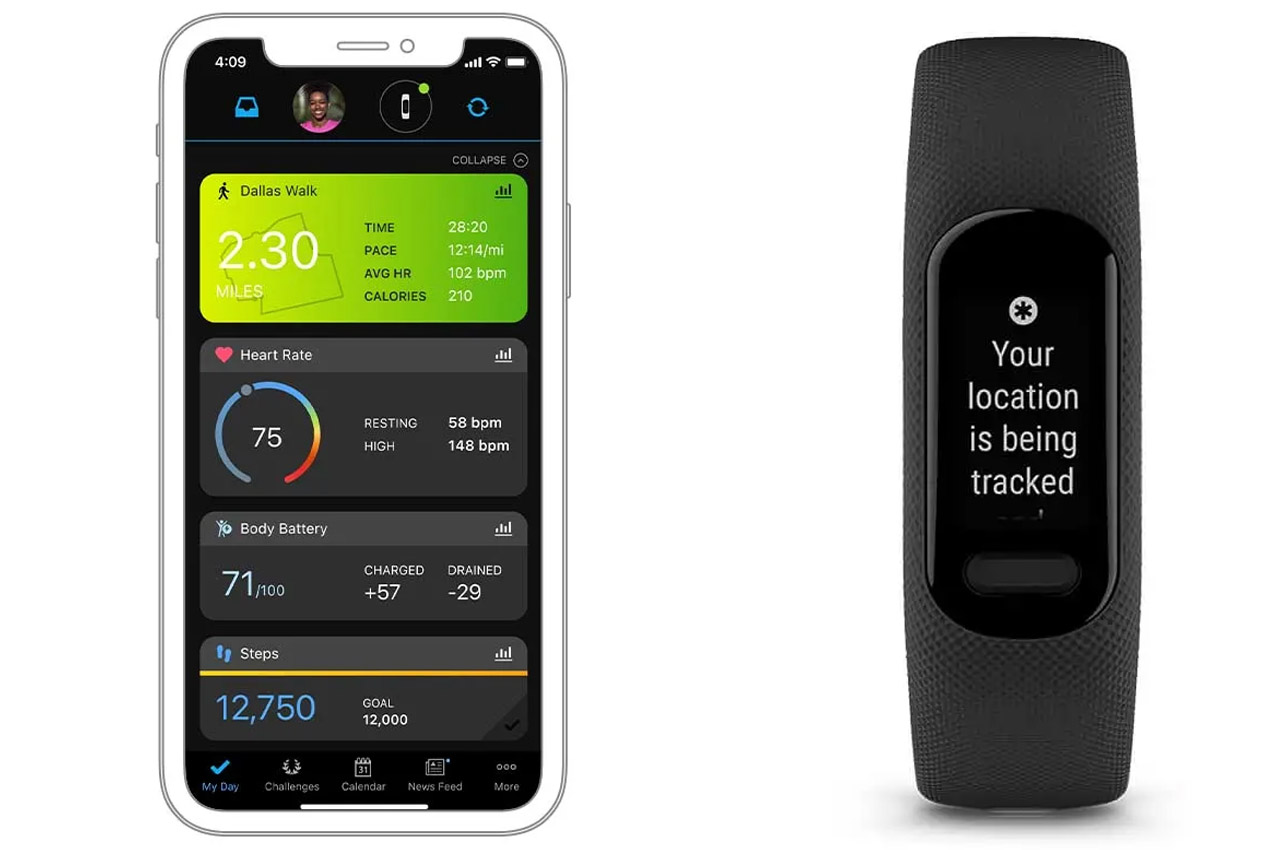
In addition to sending out a distress message with the user’s location to predefined emergency contacts, the Vivosmart 5 also provides alerts to the user when it records “abnormally high and low heart rates” than pre-configured by the user. In addition to being a well-being monitor, the Vivosmart 5 is also a capable fitness tracker. To that accord, it tracks the user’s basic activities like calories burned and steps taken. For more stringent ones amid us, it has a range of sports apps built-in for swimming, yoga, running, cycling and more.


Before we are lured into the aesthetics and workable features of the Vivosmart 5, we are instantly alarmed by the fact that it lacks an ECG sensor and doesn’t have GPS built-in. It does support connected GPS so you can connect it to your smartphone to track the speed, distance and route of your run or bike ride, but you’d have to tag along the phone every time. If that’s not too much a hassle, you’re then in for a colorful device for the wrist. Garmin will roll out the Vivosmart 5 in cool mint, white and back colors paired with interchangeable bands to suit your style. Vivosmart 5 is suggested to the retail price at $150 and tout an impressive seven-day battery backup.

https://www.yankodesign.com/images/design_news/2022/04/garmin-vivosmart-5-is-a-new-breed-of-fitness-trackers-with-distress-button-and-advanced-sleep-tracking/Garmin-Vivosmart-5-fitness-tracker-16.jpg

D&D Direct 2022: All the news from Dungeons & Dragons’ live event

D&D Direct 2022: All the news from Dungeons & Dragons’ live event

Wizards of the Coast holds its first D&D Direct, a digital presentation illuminating all things coming to Dungeons & Dragons in 2022 and beyond, on Thursday. The publisher of the original role-playing game promises exclusive reveals, not just about the core tabletop role-playing game, but media-wide: books, film and television, video games, and beyond.

If you can’t watch live, keep up with the latest news from D&D Direct 2022 in Polygon’s StoryStream below. You can also watch a replay of the event, via YouTube, when it concludes.

https://cdn.vox-cdn.com/thumbor/MpUh_TXs842pTBmgkp8UXyZQ6O0=/0x75:3840×2085/fit-in/1200×630/cdn.vox-cdn.com/uploads/chorus_asset/file/23406092/D_D_Direct_Logo.jpg

Research shows how some apps keep tracking users despite new iOS privacy features

Research shows how some apps keep tracking users despite new iOS privacy features

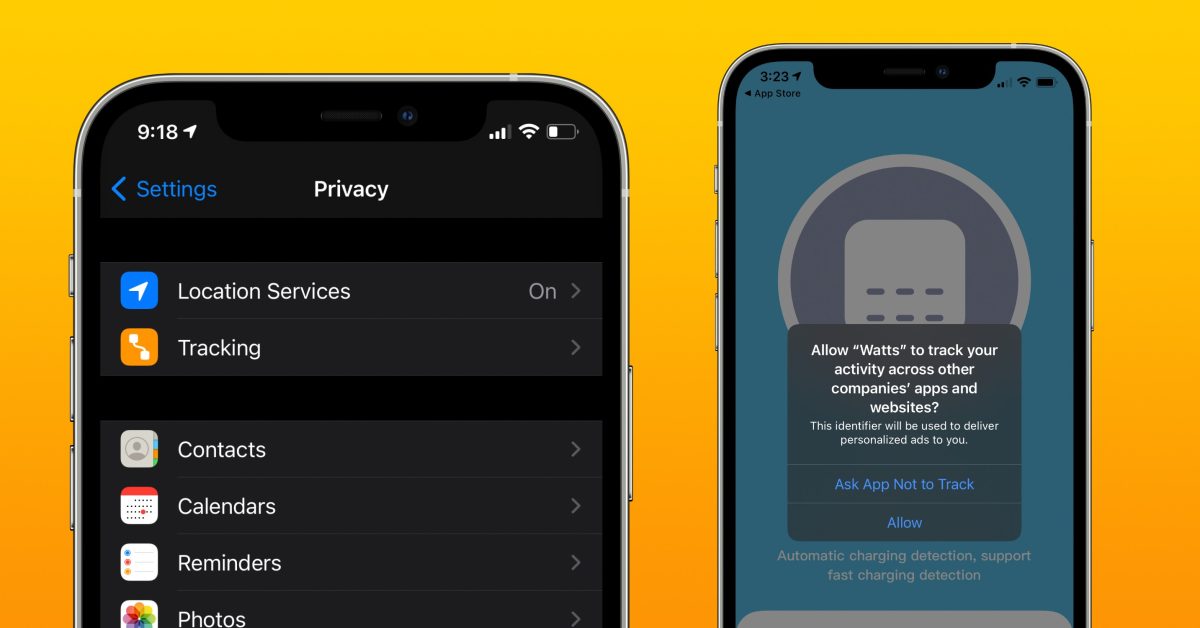
Since App Tracking Transparency was introduced last year with iOS 14. 5, every iPhone and iPad app now has to ask users whether they want to be tracked or not. However, some developers have figured out new ways to keep tracking iOS users even when they opt out of being tracked by third-party apps.


A new independent research (via Ars Technica) has revealed how these developers have been bypassing the new iOS privacy features to identify and track users even when they don’t want to. App Tracking Transparency, or ATT, is a good idea. However there are loopholes in it that allow apps to silently gather data about the device.

The researchers analyzed nine iOS apps that use server-side code to generate a user identifier even when App Tracking is disabled. This code appears to have been provided by Alibaba’s subsidiary, which can track it across all apps. Advertising companies can still target specific users with this code.

In total, the research compared 1,759 apps before and after ATT was released for iOS users. Although a quarter of these apps claim that they do not collect any user data, 80% of them still contain at least one tracking library.

Our findings show that even larger tracking companies have the ability to track their users in secret, particularly if they have access to large amounts of first-party data. They can do this through a range of methods, including using IP addresses to link installation-specific IDs across apps and through the sign-in functionality provided by individual apps (e.g. Google or Facebook sign-in, or email address).

9to5Mac’s Take

Despite all the evidence, App Tracking Transparency does not disappear. The changes in Apple’s privacy policies have in fact made it more difficult for developers to track users, and they can no longer get the same amount of data as they could before ATT even by using workarounds.

ATT remains one of the best features ever introduced to iOS, and Apple will surely make it even better every year.

Read also:

  • Number of users opting in to App Tracking on iOS grows significantly since last year

https://i0.wp.com/9to5mac.com/wp-content/uploads/sites/6/2020/07/how-to-allow-block-iphone-app-tracking-ios.jpg?resize=1200%2C628&quality=82&strip=all&ssl=1

Why doesn’t Apple Music on iOS have crossfade, but the Android app does?

Why doesn’t Apple Music on iOS have crossfade, but the Android app does?

Some of Apple’s services are available on other platforms such as Windows and Android, but usually the company keeps some features restricted to its own devices. However, when it comes to Apple Music, it’s quite the opposite. The Android version seems to have more features than on iOS. Why doesn’t Apple Music on iOS have crossfade, but the Android app does?


To put some context into this article, I recently decided to give the Samsung Galaxy Z Flip 3 a try after years of using iPhone. But since I’m not replacing the iPhone as my primary phone, I still subscribe to Apple One, which means Apple Music is still my primary music streaming service.

I was a bit afraid about what to expect from the Apple Music experience on Android – after all, we all know that using Apple Music on Windows is a nightmare. Luckily, everything works quite well. I haven’t had any issues other than those I also have using Apple Music on iOS – like having to constantly confirm that I allow explicit songs on my device.

But here’s where things start to get interesting. In some cases, it seems that the Apple Music app for Android has more features than the iOS app, which is a native app with access to all of the iOS private APIs.

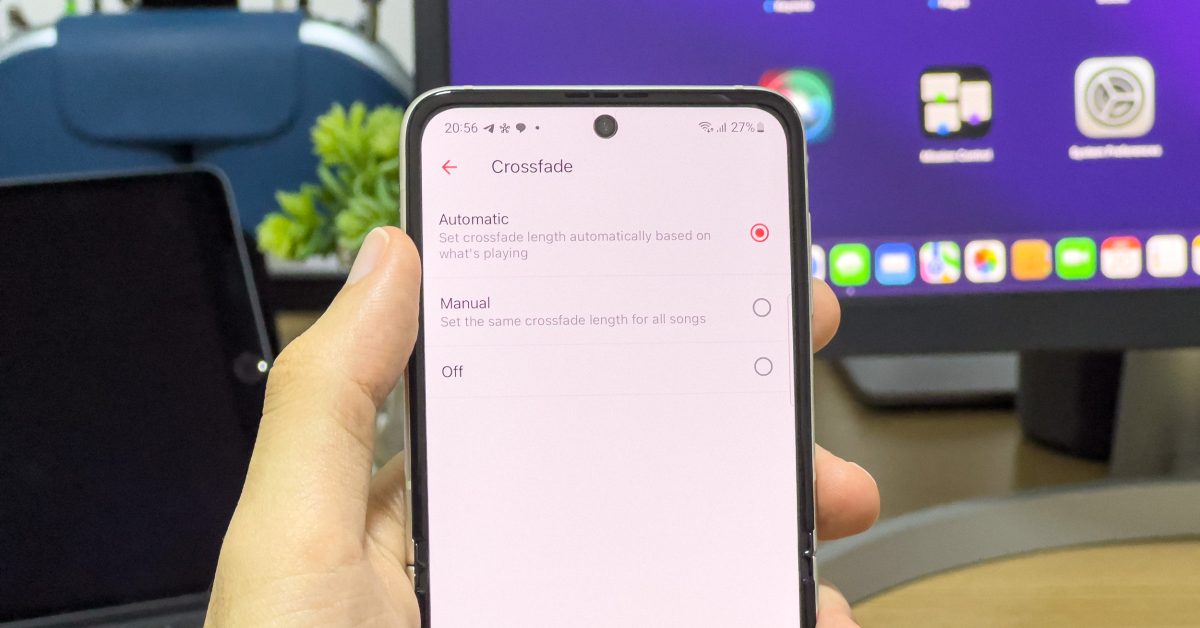
One thing I immediately noticed is that Apple Music on Android comes with crossfade enabled by default. For those unfamiliar, crossfade enables a smooth transition between one song and another, which creates an effect similar to that used by DJs to always have something playing, avoiding silence when a song ends.

Personally, I really enjoyed listening to songs with crossfade enabled, so I looked for this option in iOS. It turns out that it doesn’t exist there.

There’s more missing in Apple Music on iOS

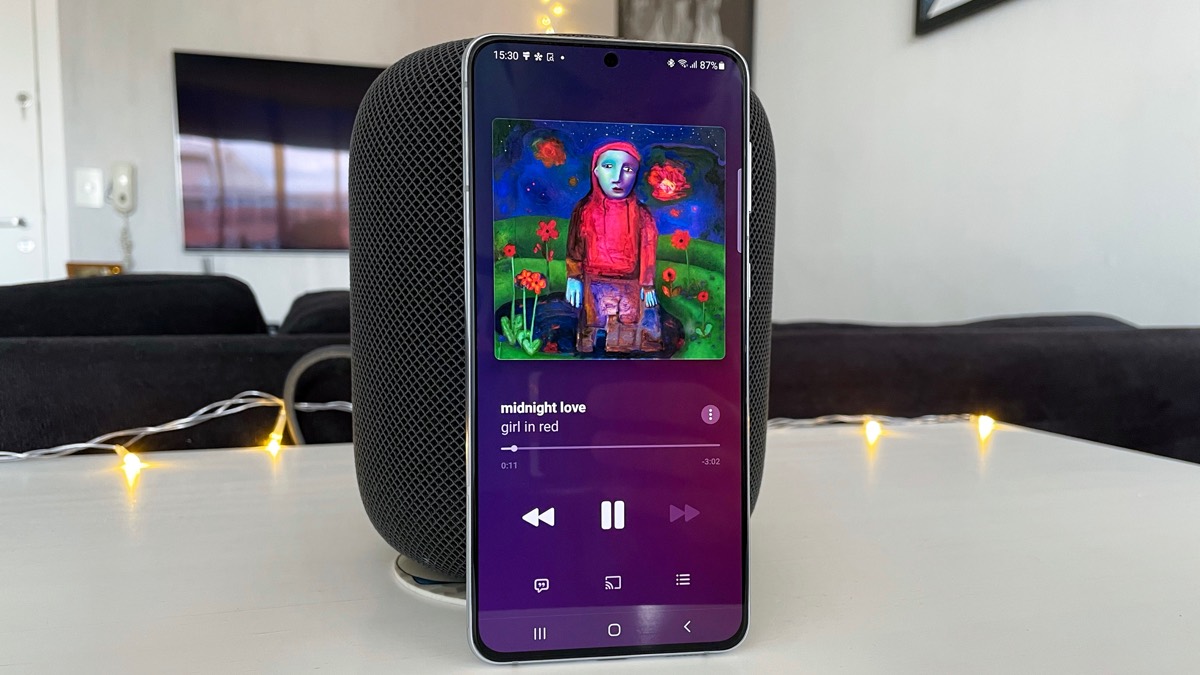
Apple Music app running on an Android phone.

However, this is only one of the features missing from Apple Music on iOS when compared to the Android app. As 9to5Mac‘s Chance Miller wrote earlier this month, Apple Music on Android was updated in 2020 with “gapless playback,” which is also a technique for eliminating silence between tracks – but without the crossfade effect. Guess what? That feature was never added to iOS.

As I looked deeper into the Apple Music app settings on Android, I also found an option to force the app to update album and playlist artworks, as well as easy access to content restriction options. None of this is available on iOS.

It’s great to see an Apple app like Apple Music on other platforms. But in what world does adding exclusive features to competing platforms make any sense? Why are these features not available for iOS users?

And last but not least, I still insist that Apple should provide standalone updates for native iOS apps. iPhone and iPad users have to wait a whole year until the next major iOS release to get some new features in apps like Apple Music, while Android apps (including native ones) can be updated at any time.

Come on, Apple. You can do better than that.

Read also:

  • Hands-on: This is what it’s like using Apple Music on Samsung’s Galaxy S21+

https://i0.wp.com/9to5mac.com/wp-content/uploads/sites/6/2022/04/Apple-Music-Android-crossfade-1.jpg?resize=1200%2C628&quality=82&strip=all&ssl=1