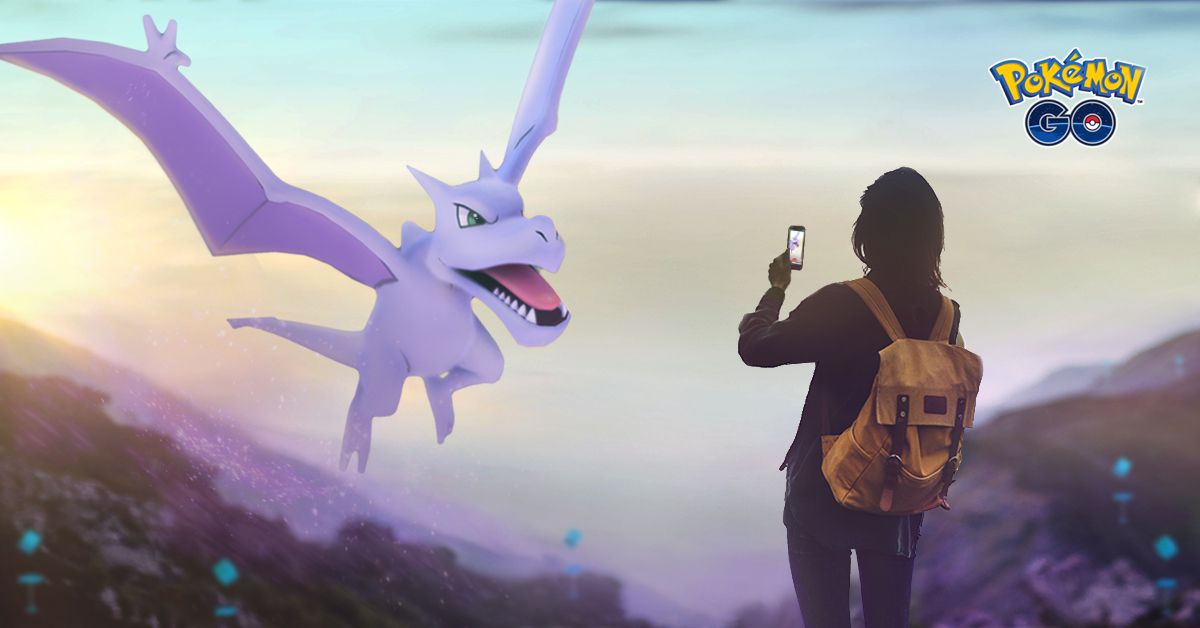
Pokemon Go may help with depression, according to a study
Pokemon Go might alleviate mild depression symptoms, it turns out. The London School of Economics and Political Science has published a new study titled “Location Based Mobile Gaming and Local Depression Trends” PokemonGo “. It argues that PokemonGo may help users with mild depression. This is because the game encourages socialization and physical activity. The Gamer first covered this study.
The study was published in Journal of Management Information Systems. It measures regional depression by using “well-established mechanisms from the medical and social health literature, internet searches of depression-related words,” to determine how many people are searching for terms such as “depression,” stress, anxiety, and fatigue in a particular region.
The data covers 166 different regions, 15 of which are in English-speaking countries, and spans a period of 50 weeks between January 1, 2016, and December 12, 2016. (Those dates include a time period that covers before and after Pokemon Go‘s release.)
Pokemon Go is a mobile augmented-reality game from Niantic in which you can battle and catch Pokemon based on your location. While the developers altered the game because of the Covid-19 pandemic, it largely requires you to actually get out and take a walk to collect Pokemon and battle with them at virtual gyms. Other features of the game, like Community Days, where certain Pokemon appear more often, further encourage players to get outside and perhaps meet other players during the event. These factors may help to reduce depression symptoms, according to the study.
If you want to connect and play with other trainers, Polygon has a complete list of PokemonGo Community Day for 2022..
T-Mobile breached by cybercrime group LAPSUS$ through compromised employee accounts
T-Mobile has suffered another data breach, this time carried out by young hackers that were part of the LAPSUS$ group. T-Mobile claims that there was no breach of customer information or government data. However, LAPSUS$ appears to have gained access both to T-Mobile’s source codes repositories and its customer management system.
Reported and seen by Krebs on Security (via TechCrunch), leaked messages between members in the LAPSUS$ cybercrime group show that they successfully hacked into T-Mobile multiple times last month.
The hackers gained access to T-Mobile’s internal systems by taking over multiple employee accounts with purchases through sites like “Russian Market,” social engineering, and other methods of stealing the information.
The messages reveal that each time LAPSUS$ was cut off from a T-Mobile employee’s account — either because the employee tried to log in or change their password — they would just find or buy another set of T-Mobile VPN credentials. T-Mobile currently has approximately 75,000 employees worldwide.
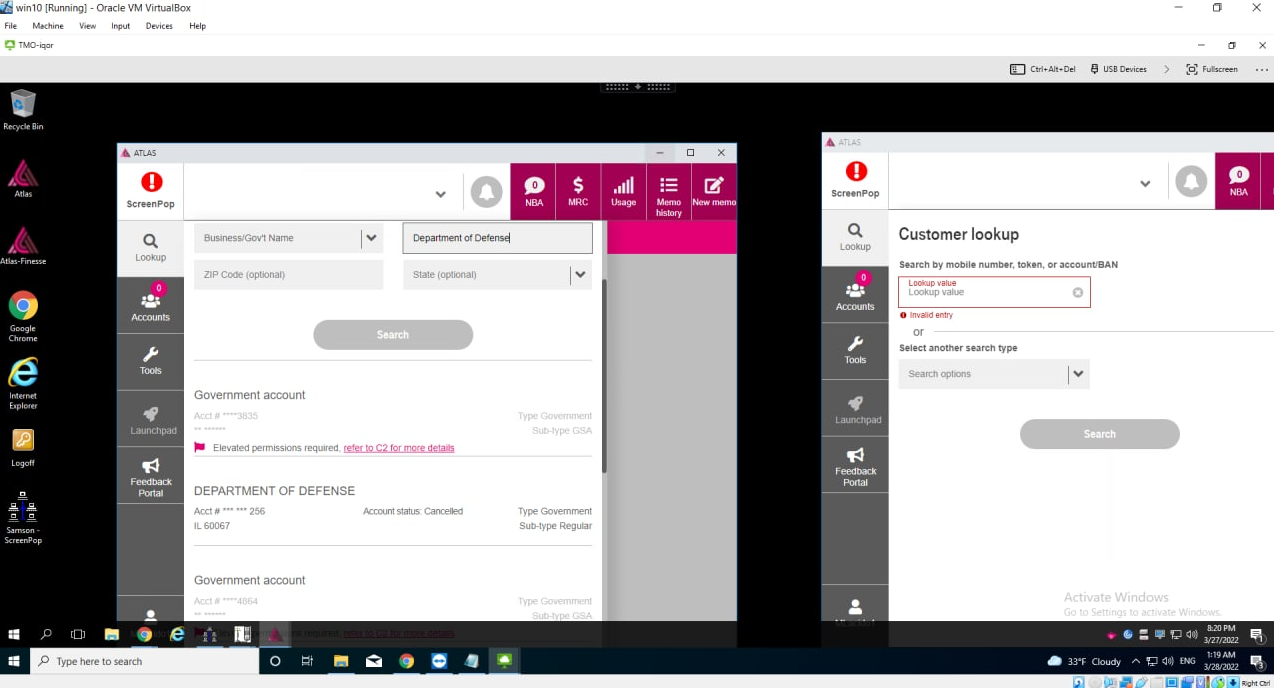
The LAPSUS$ chats and screenshots show they hacked into T-Mobile’s Atlas customer management system on March 19 and searched for “accounts associated with the FBI and Department of Defense.” But as it turned out LAPSUS$ didn’t have the additional credentials to access that information.
While some of the LAPSUS$ members “desperately wanted to SIM swap some wealthy targets for money,” their 17-year-old leader “White” decided to throw away the VPN access to the Atlas system and pivoted to exploring T-Mobile’s Bitbucket and Slack accounts.
About 12 hours later, “White” shared screenshots showing a script he created had downloaded over 30,000 of T-Mobile’s source code repositories which included content on a variety of the carrier’s projects.
In response to the LAPSUS$ hack, T-Mobile shared the following statement to Krebs on Security:
Several weeks ago our monitoring tools identified a bad actor who used stolen credentials to gain access to internal systems which house software for operational tools. We have no evidence the intruder obtained any customer, government or similar sensitive information. Our systems and processes worked as designed, the intrusion was rapidly shut down and closed off, and the compromised credentials used were rendered obsolete.
As for why LAPSUS$ decided to focus on T-Mobile source code instead of making malicious SIM swaps, Krebs on Security thinks they could have been looking for greater security flaws, already had buyers for the source code lined up, or it was potentially just “one big Capture the Flag competition.”
The most active members of LAPSUS$ were detained shortly after T-Mobile’s breach.
A look back at the evolution of iPhone hardware with GRID frames [Gallery]
It has been 14 years since the first iPhone was introduced by Steve Jobs, and a lot has changed since then. Each generation of the iPhone has brought unique advances that are sometimes hard to notice, but that have made a difference when we look back at the past. And that’s what I did with GRID frames.
Update: To celebrate Earth Day, GRID is offering a special 20% discount on all its frames. Use the coupon EARTH2022 when ordering to get the discount. The offer is valid only for April 22, 2022.
I have always loved understanding how things are made behind what we see and use every day, like the code and hardware that makes it all work. Earlier this year, I discovered GRID, a company that sells disassembled electronics in frames. I even wrote about GRID 4S here on 9to5Mac:
As someone who really likes technology (and Apple, of course), I was looking for some related decorations for my home — and then I met GRID 4S, which is literally a piece with a disassembled iPhone 4s that you can put anywhere you want.
GRID is a company that has been selling framed electronic products for some time, and they all seem pretty cool. For Apple fans, they have pieces with the iPhone 3GS, iPhone 4s, iPhone 5, and the second-generation iPod touch.
After getting the iPhone 4s frame, I had to complete my collection with other models. Seeing how the iPhone has evolved over all these years was nice, but being able to look at all the hardware evolution right in front of me is even more amazing — which is why I wanted to share this gallery with our readers.
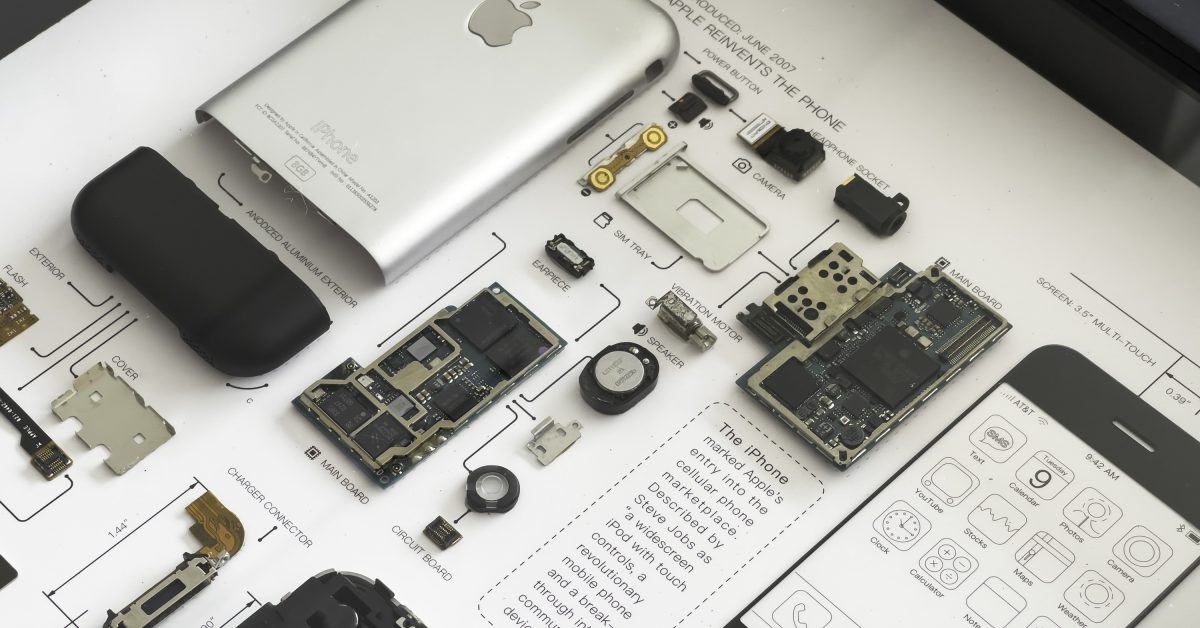
iPhone 2G
Who doesn’t remember the moment when Jobs first unveiled the iPhone in January 2007? That was an iconic moment that changed everything. And although I never had the iPhone 2G (also known as the iPhone Classic), that product made me want to go all in on the Apple ecosystem (and I ended up getting the first iPod touch that year).
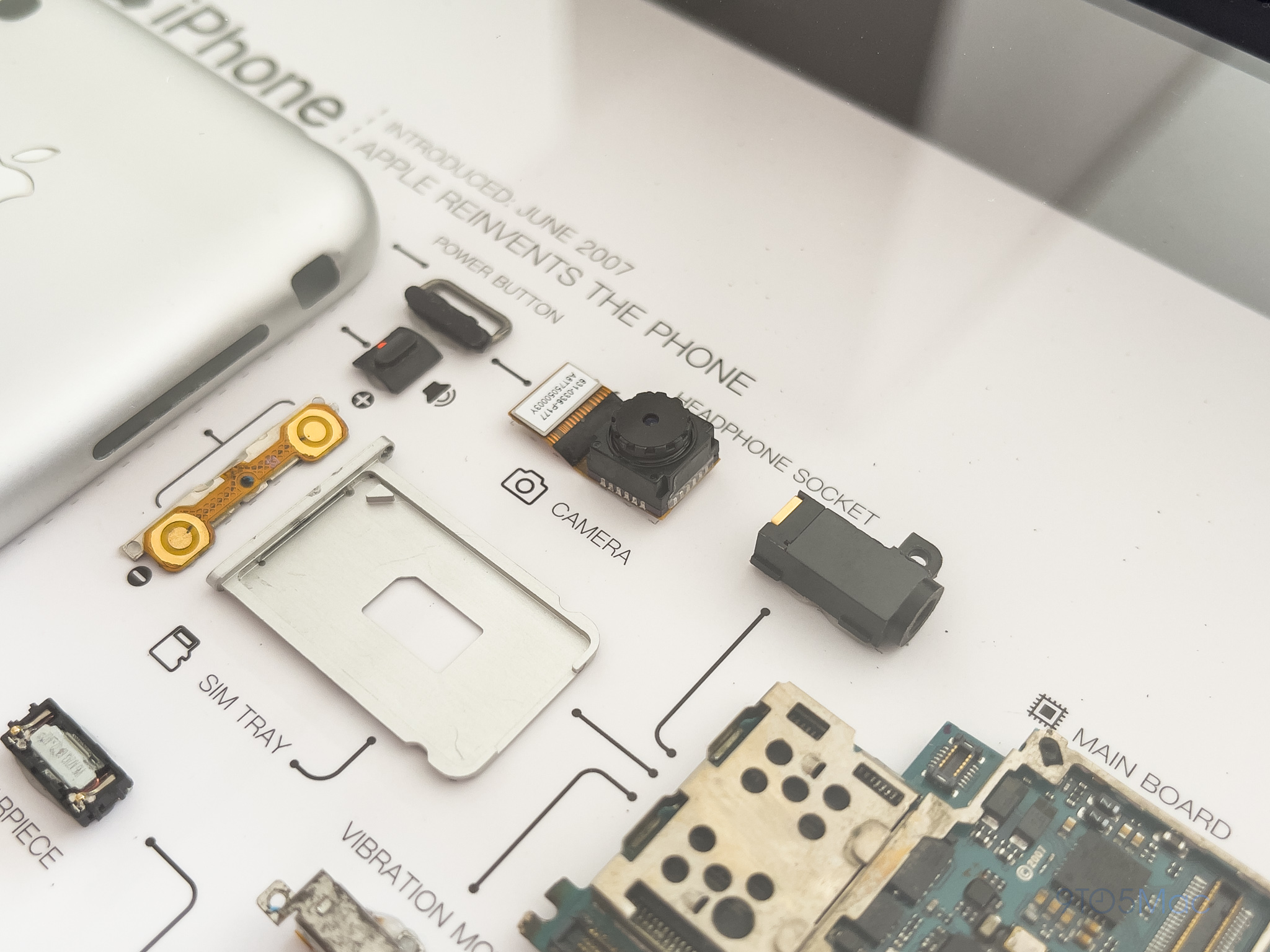
The construction of this iPhone may seem simple by today’s standards, but it was far more sophisticated than other smartphones of the time. The iPhone 2G body was made almost entirely of aluminum, but with a plastic bottom part to enable cellular and Wi-Fi signals.
This iPhone already had a built-in rear camera, but the quality was really low. Its sensor — with a really low aperture — captures 2MP photos, and it cannot shoot video. Also, it has no focus adjustment.
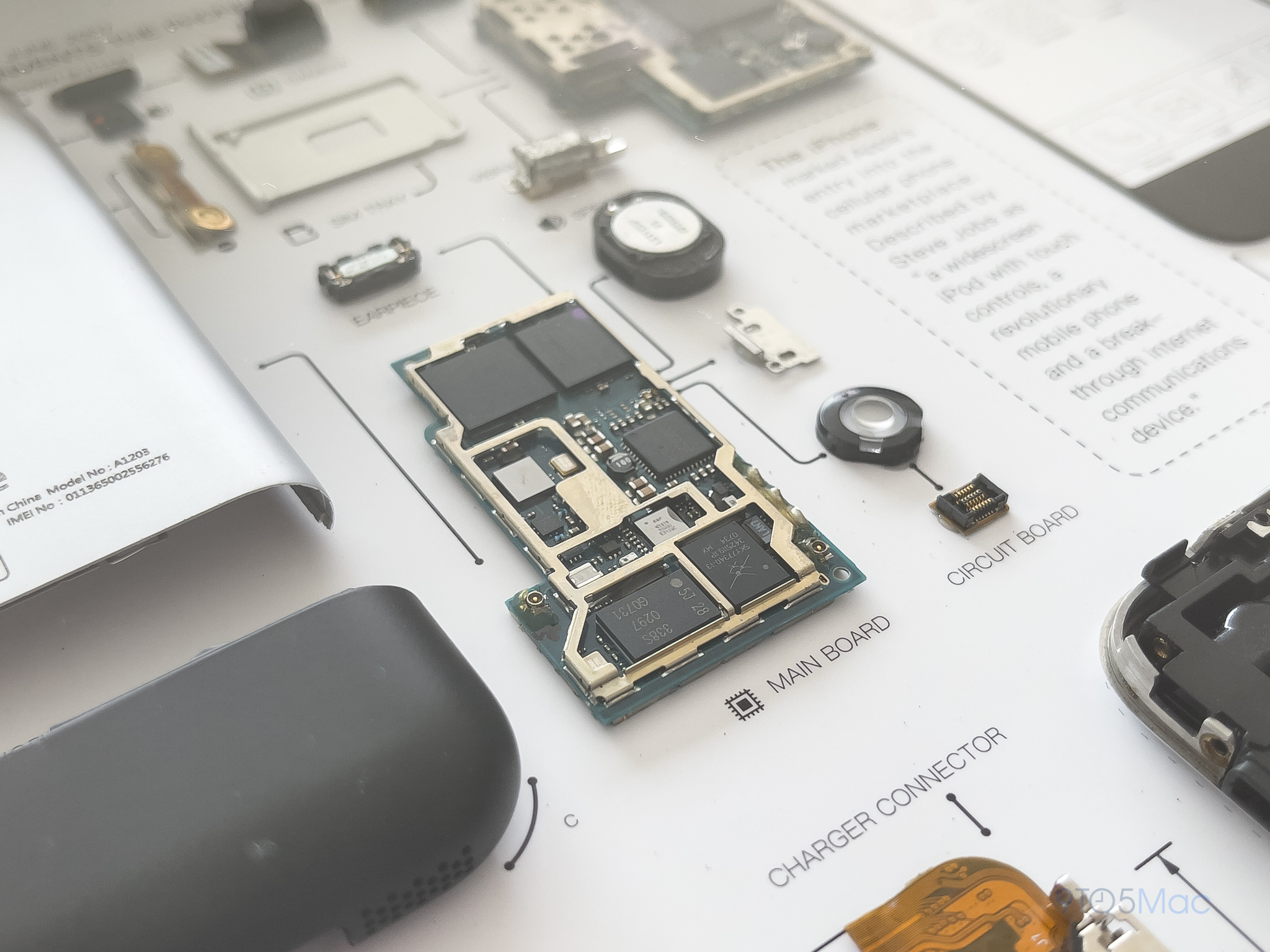
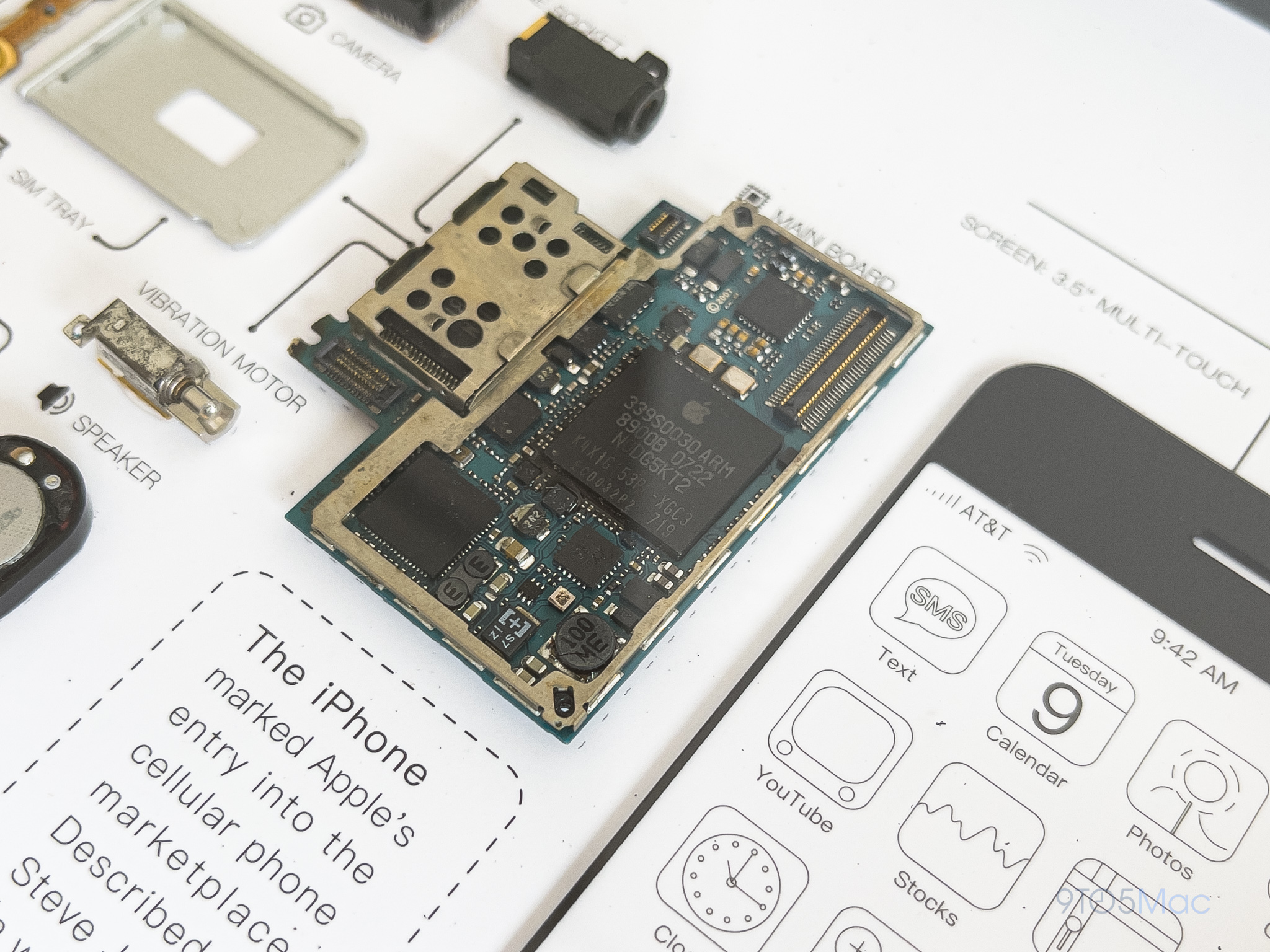
The logic board was split into two parts, and it relies on a Samsung ARM processor since Apple hadn’t yet developed its own Apple Silicon at that time. Although the CPU has a single 620MHz core, Apple has lowered the clock to 412MHz in order to save battery life. There are also other things to note, such as the simplicity of components like the speakers and vibration motor.
As a gift, GRID included the 9to5Mac logo on a metal plate that made my unit even more unique.
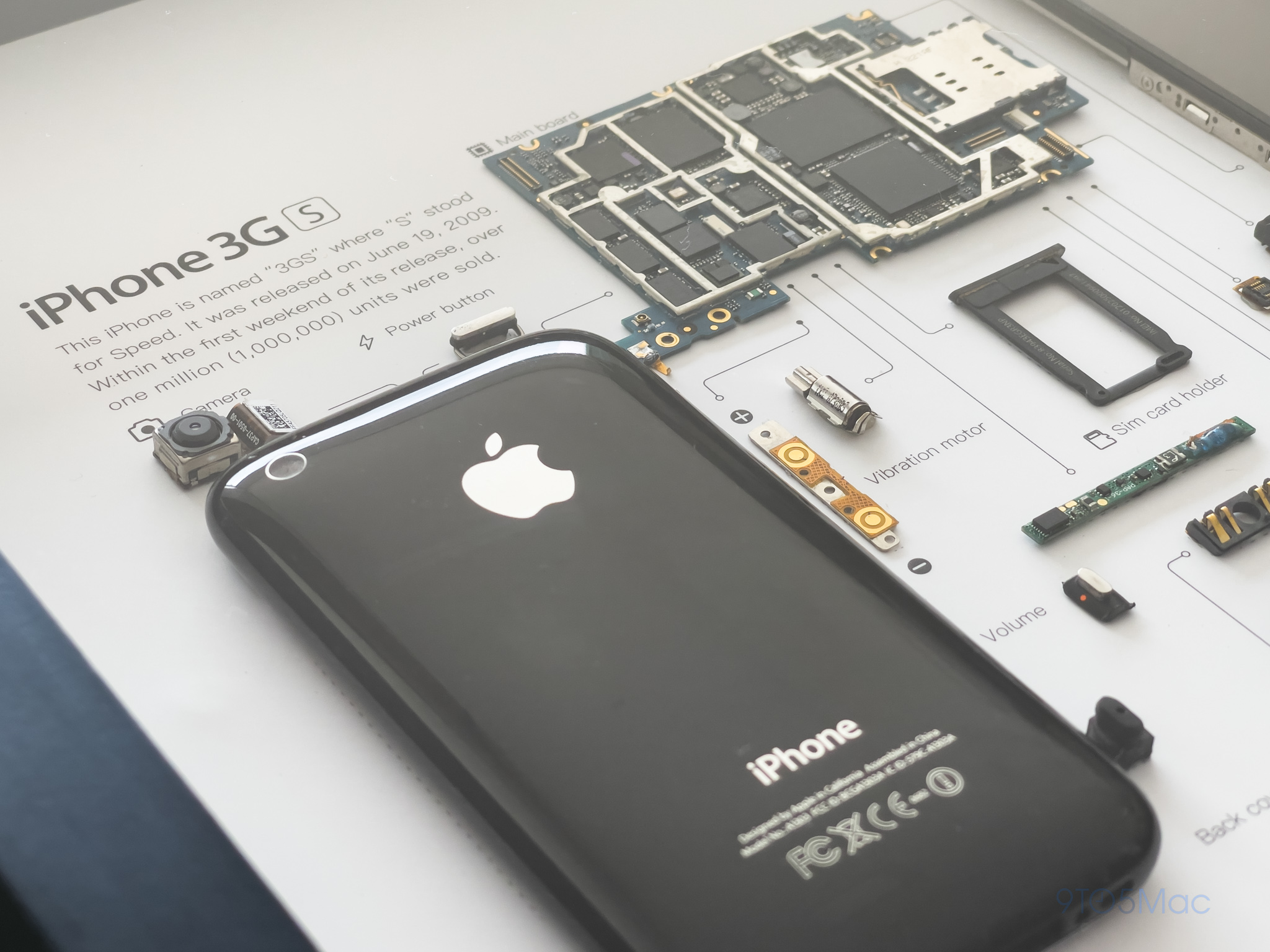
iPhone 3GS
A year later, Apple completely redesigned the iPhone with iPhone 3G. It was the first model to support 3G networks, but there weren’t many other changes to its hardware (it even uses the same CPU as the iPhone 2G). However, iPhone 3GS came in 2009, keeping the same design but with more hardware improvements.
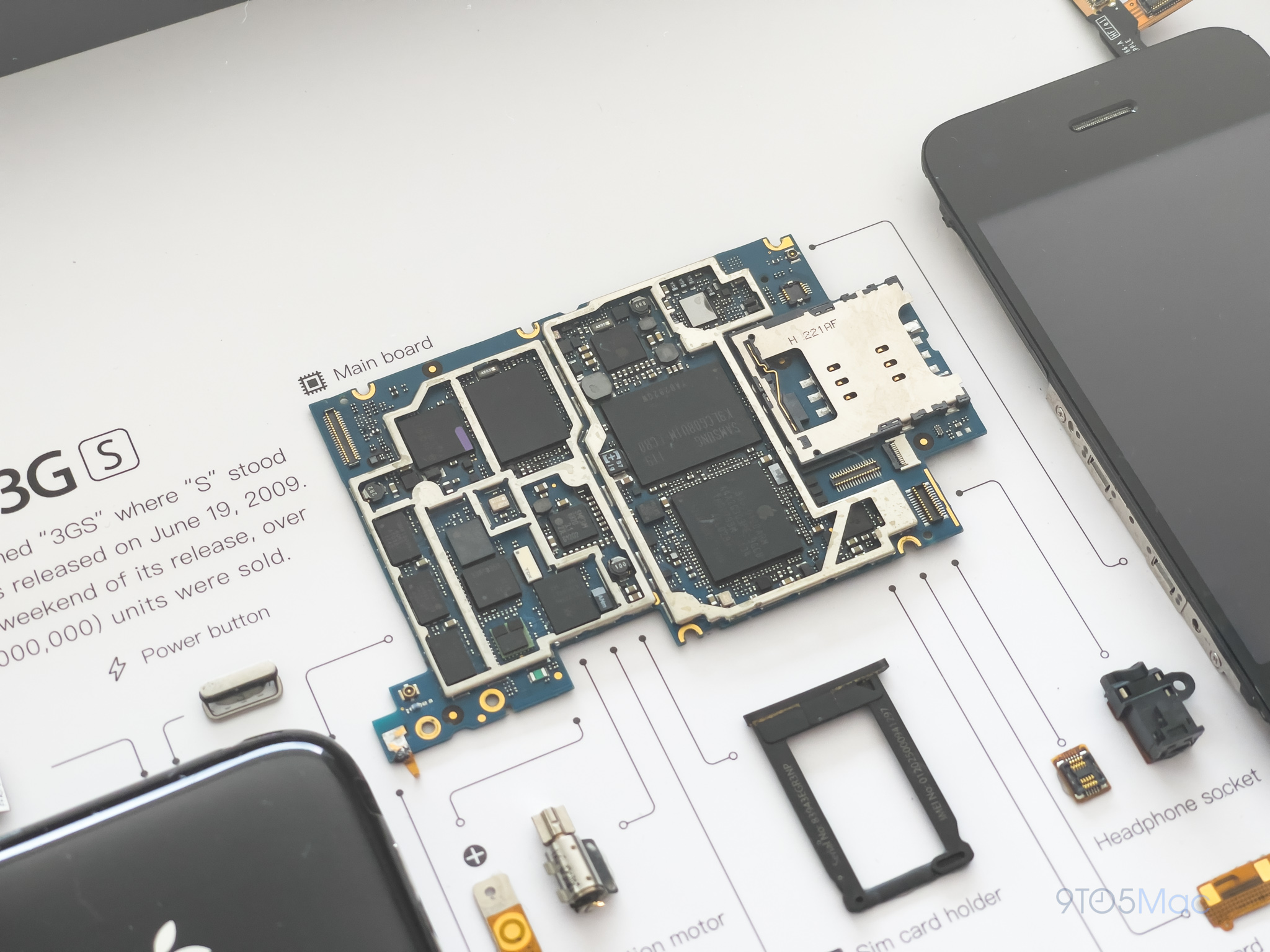
iPhone 3GS was announced at WWDC 2009 by Phil Schiller, as Steve Jobs had to leave Apple for a few months that year for a liver transplant. During the keynote, Schiller mentioned that the letter “S” stood for “speed,” since the iPhone 3GS was the first to have an upgraded processor and graphics. Also made by Samsung, this ARM processor is 600MHz.
Besides the shiny plastic back, we can notice that the iPhone 3GS camera is slightly different when compared to previous generations. Unlike its predecessors, iPhone 3GS had a 3MP sensor with adjustable focus that shoots 480p video.
It’s also cool to see how Apple brands its components, even the smaller ones like flex cables.
iPhone 4S
iPhone 4 in 2010 was the first major change to the iPhone since the original product. After a massive leak, iPhone 4 was introduced with a new glass design, Retina display, the first Apple-made A4 chip, and significant upgrades to the cameras.
In 2011, exactly a day before Steve Jobs passed away, iPhone 4S was announced at an event presented by Tim Cook, who had recently taken over as Apple’s CEO. The iPhone 4S followed the iPhone 3GS strategy of keeping the same design as the previous generation, but with more in-depth hardware improvements.
One of the main highlights was the A5 chip, the second version of Apple’s own ARM chip that was also the first dual-core chip in an iPhone. The performance of the iPhone 4S was noticeably better when compared to every other iPhone.
By looking at the camera module, it’s easy to guess that it’s much better than the cameras seen on previous iPhones. The sensor looks more advanced, as it now captures 8MP photos and, for the first time, 1080p video. It also has a small LED flash, which was introduced with iPhone 4.
The front camera was only 0.3MP, just like on the iPhone 4 (which was the first model to have one), but even so, it certainly provided amazing moments for many people on their first FaceTime calls or selfies taken with an iPhone. Look how small the front sensor is.
Overall, the internal design of the iPhone 4 and iPhone 4S is much more robust, and most components such as the buttons and flex cables seem more refined.
iPhone 6
Following the iPhone 5 and iPhone 5s, which both got a slightly larger screen, there’s the iPhone 6. I remember watching the Apple event in September 2014 and being super excited about the new iPhones, as they were much bigger than their predecessors.
iPhone 6 and iPhone 6 Plus had an all-new, more rounded design made entirely of aluminum, with the antennas embedded as plastic strips on their back. With a more compact logic board and more internal space, Apple was able to add bigger batteries to the iPhone 6 and 6 Plus (they still weren’t perfect, but much better than those in the iPhone 4 and iPhone 5).
The rear camera sensor was still 8MP, but it has more tricks. It was the first iPhone to be able to capture 1080p video at 60 frames per second, or 720p at 240 frames per second — which enabled super slow-motion. Users could capture photos while recording videos, and the autofocus became faster and more accurate. You can also see the True Tone LED flash in the photos.
Here the front camera was already 1.3MP with the ability to shoot video in 720p. In terms of performance, the A8 chip was still a dual-core processor, but now with 64-bit architecture (first introduced with the A7 chip in the iPhone 5s). The iPhone 6 still had a mechanical Home button, which was also the biometric reader.
iPhone 7
Finally, we get to the iPhone 7, which I consider the last iteration of the original iPhone form-factor before the iPhone X (excluding the iPhone 8 and iPhone SE). iPhone 7 was quite an upgrade with a refreshed look (including this gorgeous matte black version) and important enhancements.
Unlike the other iPhones, the Home button on the iPhone 7 is somewhat virtual. It is there, but it’s not a mechanical part since it works based on pressure sensors.
The four-core A10 Fusion chip was way ahead of the competition at the time, and it is still considered a great chip today. The “Fusion” name is due to the fact that this chip was the first with different cores for full performance and power efficiency.
The cameras on the iPhone 7 were quite advanced, with optical stabilization on all models for the first time. The larger 12MP sensor has an aperture of f/1.8 for capturing better photos in the dark, and it can record videos in 4K resolution. The front camera also had a giant leap with a 7MP sensor.
Components such as the Lightning port and the speakers have rubber protection, as the iPhone 7 was the first water-resistant iPhone. Speaking of speakers, look how much bigger the iPhone 7 earpiece is — that’s because it was also the first iPhone with stereo speakers. And I couldn’t forget Taptic Feedback, which is really cool to see that it looks exactly like Apple shows in its videos.
Looking ahead to the future
Nowadays, we have very different iPhones, with no Home button, much smaller chips, and advanced sensors for facial recognition. These, however, I’ll leave for another article in the future when we get to the next iteration of iPhone design.
If you also want to take a closer look at iPhone hardware or simply decorate your home with technology, check out GRID’s store to get these and other frames.
Sony WH-1000XM5 headphones to offer longer battery life and improved ANC
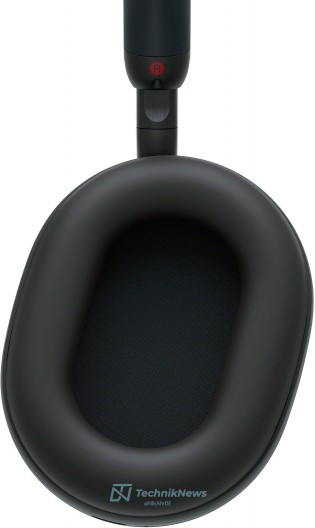
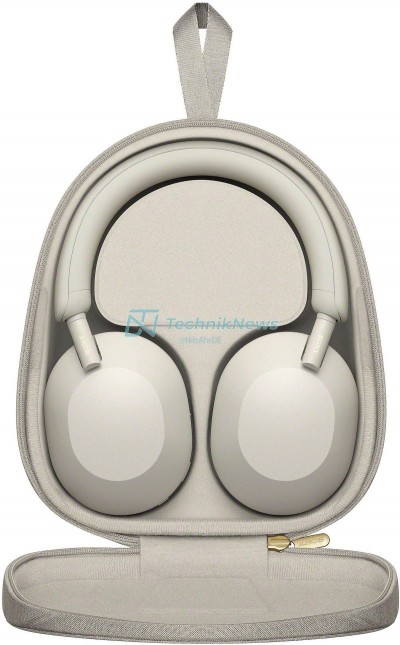
A new comprehensive leak from TechnikNews along with some official-looking renders tell an interesting story about Sony’s future ANC headphones – the WH-1000XM5.
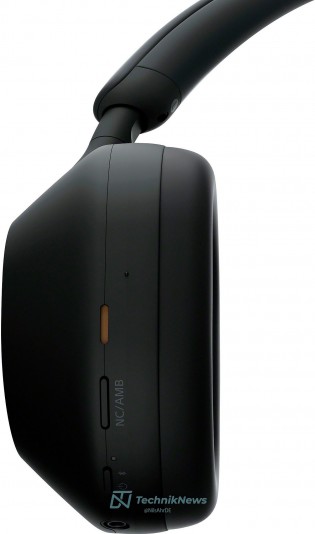
As you can see from the renders below, there are small but notable changes in the design compared to the older version. The upcoming headphones look somewhat cleaner than their predecessors, have bigger earpads and the headband seems to have a bit more padding. The hinge holding the earpads has been revamped as well. At first glance, those changes will likely contribute to a more comfortable fit.
Sony WH-1000XM5
The power button is now swapped out for a slider-type switch, while the custom button has been replaced with an NC/Ambient button.
Sony WH-1000XM5
As far as specs are concerned, the new iteration will likely deliver up to 40 hours of non-stop playback with ANC turned on, which is 10 hours up from the XM4. Expectedly, the charging time has also increased and the headphones will take 3. 5 hours to a full charge.
The source doesn’t mention anything about release time frames, unfortunately.
F1 22 release date, with new ‘F1 Life’ mode, announced for July
When it launches July 1, F1 22will lean into the fast and flashy lifestyle that Formula One fans have seen over four seasons of Netflix’s popular documentary Formula 1: Drive to Survive. Some fans worry that it will mean microtransactions and battle pass bling more than an expanded mode.
F1 Life, as it is called, is “a new space for you to unlock and show off supercars, clothing, accessories, and more for the world to see,” according to publisher Electronic Arts. The game’s official website doesn’t expand on the thought. Commenters in the F1 series’ restive subreddit wondered why EA and developer Codemasters couldn’t bring back classic competition cars, which were last seen (and driveable in most modes) in F1 2020.
“Classic F1 cars would make it so much better,” said one user. “It’s an F1 game, not a normal car game.”
F1 2020 was the first game in the series to introduce the Podium Pass, basically a schedule of tiered loot and unlockable cosmetics for use across several modes. Players have to buy into each season with Pitcoin, a secondary currency also introduced that year. Pitcoin is acquired for real money, and sometimes is awarded in one of the Podium Pass’ tiers.
The cosmetics in the Podium Pass so far involve a created driver’s racing suit, helmet, and gloves, and especially liveries for the multiplayer and career-mode car. In terms of outfits and accessories, the F1 series has never had sequences where its drivers appear in street clothes or civilian life. So, whether F1 Life means a fresh set of cutscenes to show off these unlockable customizations, as drivers walk the paddock on the way to practice or qualifying, or something more interactive, remains to be seen.
Other promises made with F1 22‘s announcement on Thursday include “the opportunity to choose between immersive and broadcast style Formation Laps, Safety Car periods, and Pit Stops.” This likely points to an expansion of commentary from host David Croft and analyst Anthony Davidson, which so far has been limited to pre-race grid introductions and post-race driver-of-the-day honors, with zero audio from the pair during the race itself.
Of course, F1 cars have changed dramatically with the introduction of new rules, and the vehicles in F1 22 will reflect that, including the new shape of the rear wings, back canopies, and wheel guards that distinguish this year’s chassis. Such aerodynamic changes were made to foster tighter racing and more overtaking opportunities in real life, and Codemasters says F1 22 will feature “a new handling model that recreates the intense wheel-to-wheel racing that’s had us on the edge of our seats so far in the 2022 Formula 1 season.”
New courses, such as the Miami International Autodrome, whose inaugural Miami Grand Prix will race on May 8, will be included in the game. Also, sprint format qualifying — where a shorter (100 km) race on Saturday sets the grid order for Sunday — will be included in all of the relevant modes. F1 Sprint races will be staged at three events this year, beginning with this weekend’s Emilia Romagna Grand Prix at Imola, Italy. The format was introduced into competition last year but was not present in F1 2021.
When The Elder Scrolls 3: Morrowind was released on May 1, 2002, my preteen life was little more than a series of impulses dribbling out of my underdeveloped brain like an embarrassing ooze. Pants that looked like the walls of a dungeon were my entire identity. All that distinguished one day from the next was whether or not my health teacher would draw a dick on the white board in health class. (He did it a lot.) I was apathetic and sheltered, adrift in a hell that looked a lot like the Garden State Plaza, until one day I awoke on a boat, as a prisoner born on a certain day, from uncertain parents.
I’ve always gravitated toward games with some semblance of freedom. Zipping through the clouds in Skies of Arcadia was mind-blowing, as was running around Shenmue’s Yokosuka and questioning weirdly hostile NPCs about the whereabouts of sailors. There were invisible walls and locked doors, but I could go mostly where I wanted, unconstrained by consequence and the judgment of others.
Morrowind was hardly my first video game, but it was my first true love. When I was desperate for meaning, and life was at its most unsalted saltine, this was a Flavor Blasted Goldfish. I played games before, but this was more like an alternative to reality. It was open beyond comprehension long before the ubiquity of open worlds. My small, mundane existence was supplanted by possibility, mystery, and horror in equal measure. This game fundamentally altered the standard by which subsequent open-world RPGs would be judged. It changed everything.
Image: Bethesda Game Studios/Bethesda Softworks via Polygon
I didn’t have friends in school, but the denizens of Vvardenfell weren’t concerned with my lack of social standing. They sought only to criticize my outlander status, or for running around in the nude, or for keeping them from the important work of meandering around a 5-foot radius and staring blankly into the distance. The game’s voice acting was pretty limited as well, with dialogue delivered mainly via text boxes. This came with the fun benefit of allowing me to assign any tone I saw fit to an NPC’s rambling — I often took undue offense and murdered many innocent townspeople, screwing myself out of future quest lines in the process.
That was one of the many wonders of Morrowind: You could fuck yourself in ways that defied imagination. In fact, Morrowind offered a game-breaking degree of freedom. Some modern games offer branching decision trees under the veil of agency, but end up funneling everyone toward the same conclusion regardless. But in Morrowind, there were no such gimmicks. In fact, there was sometimes no fail state at all. There wasn’t a Game Over screen after you killed a shady moon-sugar addict and “severed the thread of prophecy.” You could play for tens of hours before realizing the implications of dropping a key item somewhere in a sewer. The creators at Bethesda did not think to protect us from ourselves. Playing Morrowind, I was Colonel Kurtz’s snail crawling along the edge of a straight razor.
Subverting your better judgment didn’t always lead to failure, though. In some cases it led to further adventures. If one was feeling particularly ballsy, they could kill the God-King Vivec and tumble headfirst down a rabbit hole of an entirely alternate main-quest path. This information was not telegraphed to the player at the outset. Instead, it was a reward that only those with hubris enough to kill a god would be privy to. The absence of explicit direction was a fundamental aspect of Morrowind’s genius design that has only been rivaled in recent years by Breath of the Wild and Elden Ring. As in those games, new quests in Morrowind were found organically — through conversation and action rather than running toward the nearest map icon.
Image: Bethesda Game Studios/Bethesda Softworks via Polygon
Curiosity, not waypoints, fueled exploration on the island of Vvardenfell. Morrowind came before we were all indoctrinated into the cult ofQuality of Life. Convenience can temper frustration, yes, but it can also reduce an otherwise rich experience into something mindless. Morrowind preserved the magic by stubbornly refusing to spoon-feed its players. Navigation was aided by the physical map, the often ambiguous (and sometimes straight-up incorrect) directions shared by quest givers, and the player’s own questionable instinct. Fast-travel options were available but limited to specific locations. And you were on your feet most of the time, so the island felt huge — despite the game’s god-awful draw distance.
With so much to explore and discover, stumbling into the unexpected came to be expected. After chatting with a tax collector about sweet roll-related issues, you could proceed outside the village bounds of Seyda Neen and be greeted with a loud shriek. It was a wizard falling from the air to his death. On his corpse was a journal, outlining the hubris which resulted in the broken corpse before you. Along with a spell that fortified acrobatics to a dangerous degree, Tarhiel’s final moments lent a pervasive sense of awe that colored the entire journey moving forward. It seemed like anything could happen, untethered from concrete quests and assignments, as long as you were in the right place at the right time. The map was brimming with possibility.
There was so much packed into that island. The geography varied from swamps to grasslands to the gray hell of Red Mountain, with vibrant mushroomy flora along the way. The skyboxes were often glorious, if they weren’t obscured by a roving band of Cliff Racers (footage of these creatures would not be out of place in A Clockwork Orange’s aversion therapy). And the water. Everyone’s heads exploded over Far Cry’s water, while Morrowind’snever got the recognition it deserved. It was shiny, ripply, and wet-looking — everything you want in a good water. Beneath the surface was a blue void that concealed treasure, sunken ships, and skeletons.
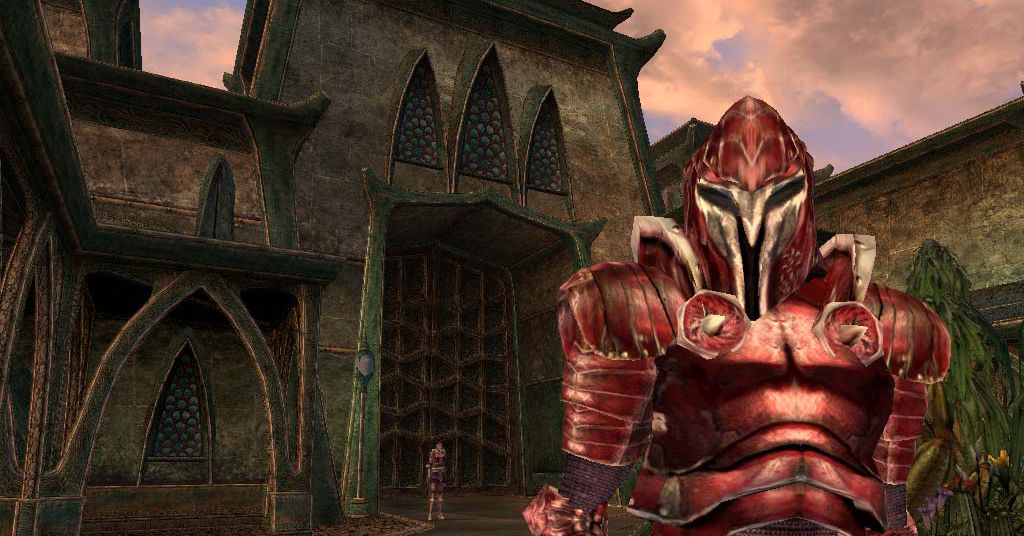
The architecture was as diverse as the geography. Each of the three Great Houses had a prevailing design aesthetic that reflected their unique sensibilities, as well as discrete senses of place. I was partial to the twisting towers of House Telvanni, carved out of giant mushrooms with vertical halls that required levitation to navigate. House Redoran’s structures looked like insect carapaces, while House Hlaalu featured the least fantastical style (although I do have a soft spot for it, since the Hlaalu-aligned city of Balmora was my character’s hometown). It is worth noting that most of the game’s cities were congruous with the rest of the map. The absence of a loading screen when entering a settlement meant you could stumble into one basically by accident.
Image: Bethesda Game Studios/Bethesda Softworks via Polygon
Maybe Morrowind felt familiar and comforting because, just like real life, there was no shortage of places where I felt unwanted. Daedric shrines were as dangerous as they looked, composed of contorted heaps of sharp black metal and cage-like structures. Dwemer ruins were abandoned industrial halls where you could observe the remnants of a once-flourishing society. There, you might run into an Ascended Sleeper, a Lovecraftian nightmare of eyeballs and tentacles (and the nickname I give myself two hours after ingesting an indica-dominant edible). Aside from these sprawling ruins, there were plenty of smugglers’ caves and tombs in which I could explore, plunder, and die.
Every play session would yield something new and exciting. Hop along the smaller land masses that dot the shoreline to meet a perpetually inebriated and extremely wealthy Mudcrab merchant. You might encounter a lone Nord, tricked by a conniving witch and left to wander the land naked and angry. These passing interactions and tangential adventures would hijack the attention of even the most singularly focused explorer. Elden Ring might represent the natural evolution of this idea, with the density and complexity of its world design standing in for Morrowind’s side quests and character interactions. These games are like dining in one of those conveyor belt sushi restaurants, with every passing whim so thoroughly indulged.
Where streamlined progression systems tend to reduce modern RPGs to action games, Morrowind was a role-playing game in every sense. Player ability was second to that of the player character. The success of an action was determined by probability, hence why you could swing your sword haplessly at a Slaughterfish and do no damage. It was the tabletop-inspired role-playing of it all that made it simultaneously so maddening and so rewarding. Skills would increase through use, so if you picked locks, your Security would increase. Due to the relationship between skills and governing attributes, player characters were much more specialized. They were unlikely to assume that nebulous jack-of-all-trades role where progression in all things becomes an inevitability.
Image: Bethesda Game Studios/Bethesda Softworks via Polygon
I felt a tremendous sense of ownership over my characters because they were a reflection of my decisions, rather than an arbitrary allocation of skill points. This system was not without its shortcomings, though. For one, it was easily exploitable. Only a player’s commitment to role-playing would keep them from hopping to their destination instead of walking in order to greatly increase their acrobatics skill. That being said, my Nerevarine was Easter Bunny-themed — so this type of behavior made perfect sense.
Morrowind was the perfect thing at the perfect time. It disemboweled my sad goth girl identity and divided my life into two halves: one defined by insecurity and apathy, and another touched by the (Daedric) Face of God. It awakened me to the possibilities of video games, not only in a technical respect, but insofar as how they affect me as a player. Games have come a long way in the decades since its release, but I still find myself holding everything against the impossible standard that Morrowind set. Despite some games coming close, I’m still in constant pursuit of one whose freedom can spark that same feeling of wonder that Morrowind gave me 20 years ago.
9to5Mac Happy Hour 378: Apple privacy stance impeding features, mourning the HomePod and iPhone 14 camera rumors
Benjamin and Zac start off by discussing the surprising firmware update for the MagSafe Battery Pack. We continue our wish that Apple would bring back the large HomePod. According to The Information, Apple’s strict privacy policies are hindering innovation. And finally, there’s a handful of iPhone 14 rumors to digest.
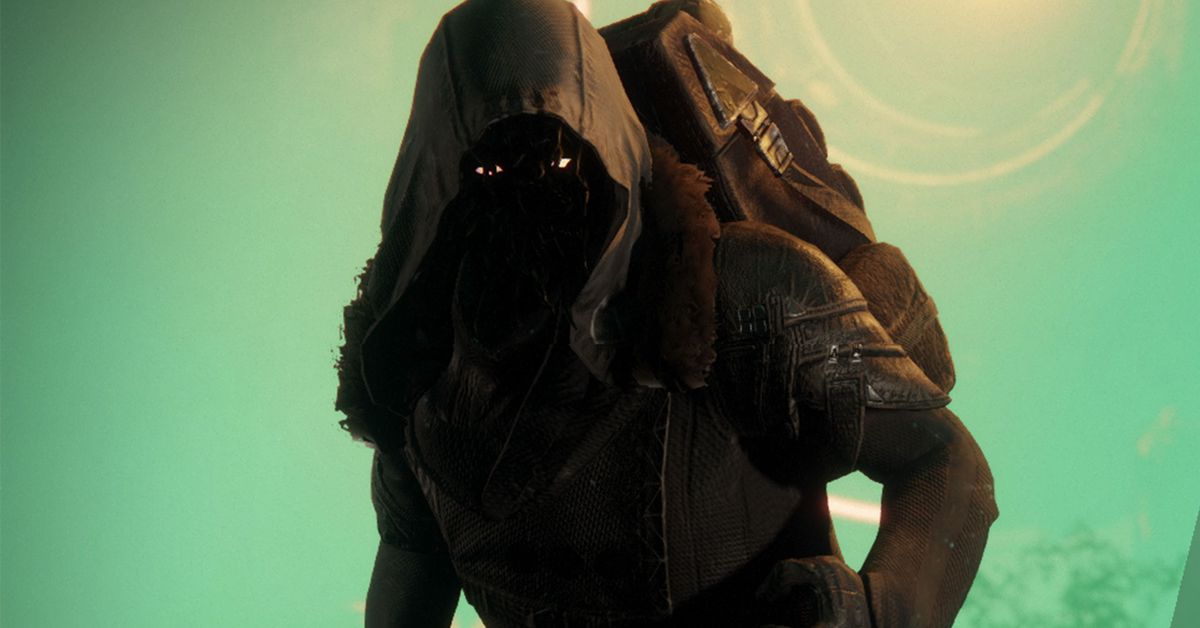
The weekly Exotics item merchant, Xur hangs out at random places around Destiny. In Destiny 2, he can appear all over the map, as well as inside the Tower. This week, you can find Xur in the EDZ, standing on a bluff overlooking the Winding Cove.
Image: Bungie via Polygon
Xur’s inventory this week consists of the following:
Prometheus Lens, Solar trace rifle: 29 Legendary Shards
Dead Man’s Tale, Kinetic scout rifle (Fourth Time’s The Charm): 125,000 Glimmer, 200 Legendary Shards, Exotic Cipher, Ascendant Shard
As of Season of the Lost, Xur also sells a collection of old armor and weapons — similar to Banshee-44 and Ada-1. Usually, these items are difficult to find and from seasons long past. Each item (whether armor or weapon) costs only 1,000 Glimmer and 50 Legendary Shards.
Xur’s Legendary inventory this week consists of the following:
Seventh Seraph SI-2, Void sidearm
Ikelos_SMG_V1.0. 2, Arc submachine gun
Wolftone Draw, Arc bow
Deafening Whisper, Void grenade launcher
Iota Draconis, Solar fusion rifle
Temptation’s Hook, Arc sword
Frozen Orbit, Void sniper rifle
Season of the Splicer armor set
Xur’s items drop at a power level similar to that of your character.
Prometheus Lens
Prometheus Lens is an Exotic from Curse of Osiris. It used to be one of the most powerful weapons in all of Destiny 2, when abug (now fixed) caused it to deal ludicrous damage in PvP. Prometheus Lens is still awesome for clearing out large crowds of enemies all at once.
The main perk, Prismatic Inferno, causes Prometheus Lens’ beam to grow in size the longer you hold down the trigger. The trace rifle can do significant damage over a wide area. The gun’s secondary ability, Flame Refraction, makes the first perk even better, allowing kills to return ammo back into the magazine. The more kills you get, the longer you can hold down the trigger and increase your area of damage. It’s a fun gun and definitely worth the Legendary Shards.
The Bombardiers
The Bombardiers are Year 3 Hunter legs with a silly and mostly useless perk — or rather, it used to be useless. Parting Gift leaves a bomb on the ground when the Hunter dodges, which then explodes and deals a bit of damage. Although it didn’t previously do anything, this bomb changes depending on the subclass you are. It can burn enemies with Solar and slow them down with Stasis. Blind targets with Arc. Void targets will also be affected. It’s a strange Exotic, but it’s still useful.
Xur’s roll this week comes with 58 total stats.
Armamentarium
The Armamentarium is a pretty simple chest piece. Its exotic perk is And Another Thing, which causes you to gain another grenade charge regardless of the subclass you’re using. It’s a great perk, but it wouldn’t be possible if Striker Titans already had two grenades. Other Titan subclasses are equipped with far more powerful grenades and exotics such as Mask of the Quiet One and Hallowfire Heart.
However, Armamentarium is still a great chest piece to grab if you don’t like those other exotics, or if you want to run the other Striker tree. This chest piece is a must-have for anyone who likes grenades and Titans.
Xur’s roll this week comes with 65 total stats.
Getaway Artist
Getaway Artist is a new Warlock Exotic from Season of the Drifter. Its Exotic perk is Dynamic Duo. This perk allows you to give up your grenade for an Arc Turret that will follow you. The Warlock Exotic Getaway Artist can be a fun, cool Warlock Exotic. It’s a great Warlock Exotic that you need to have in your collection.
Xur’s roll this week comes with 64 total stats.
Exotic Cipher quest
Image: Bungie via Polygon
Starting in Beyond Light, Xur has a new quest for an Exotic Cipher. You can buy Exotics at the Monuments to Lost Light kiosk located in the tower with the Exotic Cipher. These items will be required along with other currency to purchase Exotics such as Heir Apparent or Truth.
This week, Xur wants you to complete 21 Strikes or win Crucible or Gambit matches. By finishing the quest, you’ll earn an Exotic Cipher to use however you want.
Apple to discontinue its Mobile Device Management platform Fleetsmith
Apple bought Mobile Device Management Platform Fleetsmith almost two years ago. This partnership gave customers a first-party MDM solution for their business. Now the tech giant has announced that it is discontinuing further service through Fleetsmith.
New signups for Fleetsmith are discontinued as of April 21. Apple states that existing customers can use the Fleetsmith service until October 21, 2022. Customers can’t log into fleetsmith.com after that date. Fleetsmith servers will not allow devices to receive configuration profiles.
The service was originally acquired to help small businesses simplify its use of Apple devices. Since then, the Cupertino company has introduced Apple Business Essentials. Apple Business Essentials offers device management, 24/7 phone support for users, iCloud storage, and onsite repairs. It’s perfect for businesses looking to simplify its IT processes. While on the cusp of Worldwide Developers Conference (WWDC) 2022, it’s exciting to wait and see if we hear of any updates to Apple’s enterprise strategy.
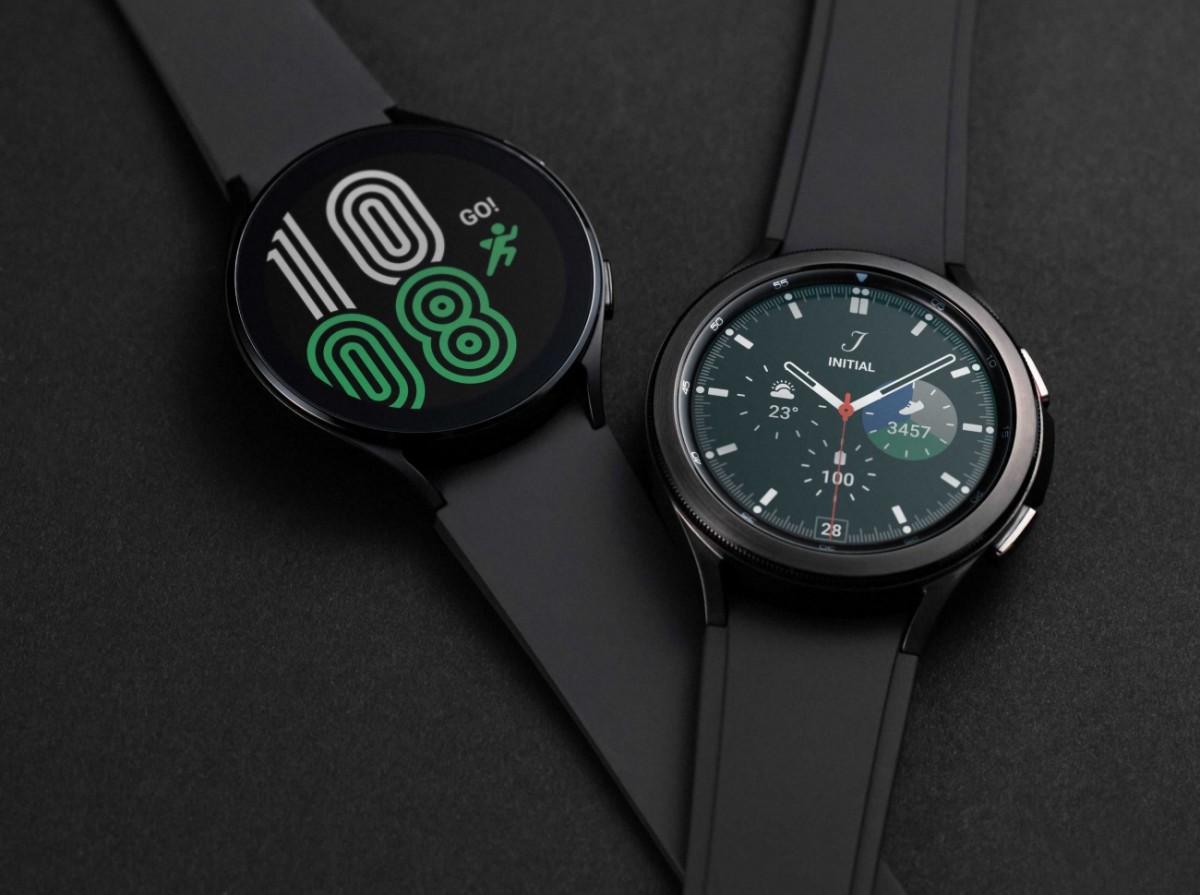
Samsung Galaxy Watch5 series details leak, there won’t be a “Classic” anymore
We are still a couple of months away from the release of the Galaxy Watch5 series, but SamMobile has a spicy rumor to share. According to the publication’s sources, Samsung is killing the “Classic” watch and replacing it with Pro. The standard option remains with the Watch5.
It’s not clear what caused this naming change. It could mean that Samsung is ditching the rotating bezel, or it could also be just a simple rebradning for some marketing reasons. The report also contains other pertinent information.
Samsung Galaxy Watch4 and Watch4 Classic
For instance, the regular Watch5 will come in two sizes, while the Pro will likely be sold in just one size. Previous rumors also suggest that the latter will incorporate a big 572 mAh battery.
Lastly, to no one’s surprise, the new round of watches will keep the circular design and will run on the One UI Watch platform based on Wear OS 3.












:format(webp):no_upscale()/cdn.vox-cdn.com/uploads/chorus_asset/file/23409393/Market_Morrowind.png)
:format(webp):no_upscale()/cdn.vox-cdn.com/uploads/chorus_asset/file/23409398/Mushrooms_Morrowind.png)
:format(webp):no_upscale()/cdn.vox-cdn.com/uploads/chorus_asset/file/23409408/Viaduct_Morrowind.png)
:format(webp):no_upscale()/cdn.vox-cdn.com/uploads/chorus_asset/file/23409413/Tavern_Morrowind.png)

:format(webp):no_upscale()/cdn.vox-cdn.com/uploads/chorus_asset/file/9787955/Xur_EDZ.png)
:format(webp):no_upscale()/cdn.vox-cdn.com/uploads/chorus_asset/file/22036052/Destiny_2_Screenshot_2020.11.13___11.27.00.57.png)